
Coreopsis verticillata ‘Moonbeam’
Blooming Time
Exposure


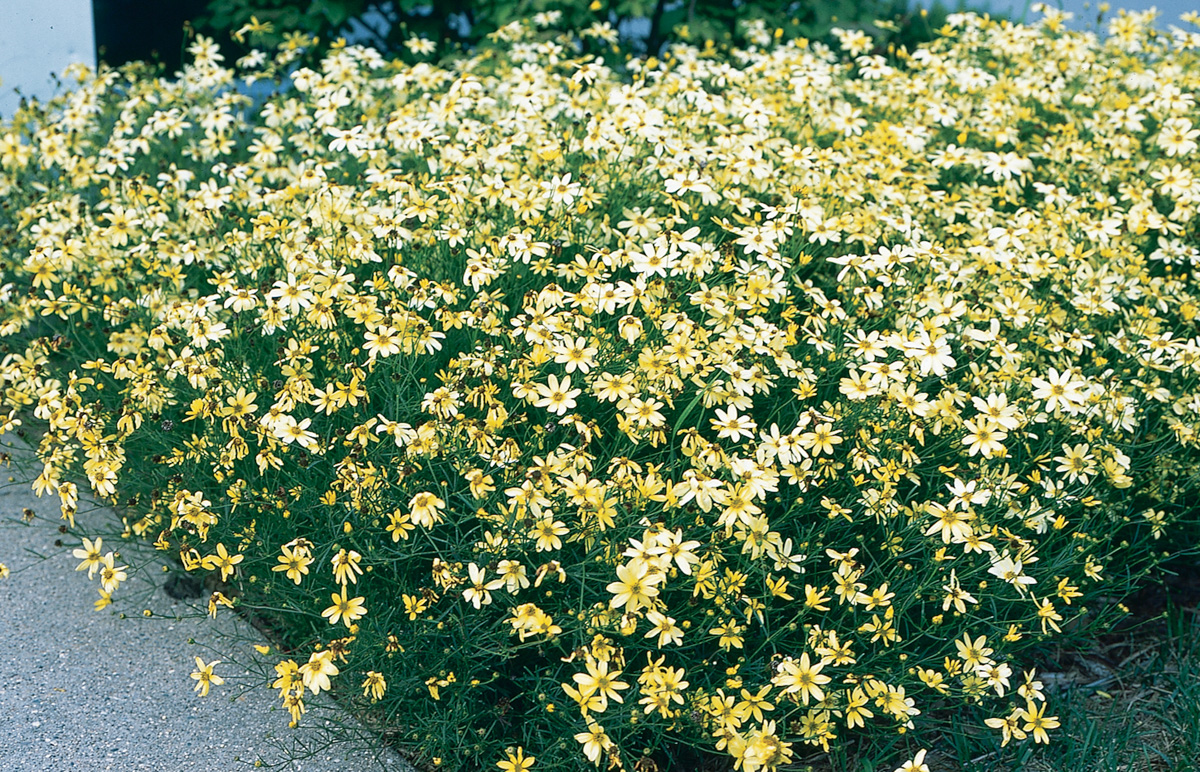
By all accounts this is one of the finest, most utilitarian of the perennial ground covers. It is durable, drought and pest resistant, and provides a magnificent summerlong floral display. The neat-as-a-pin deciduous foliage is medium green, narrow and fernlike. Borne on vertical stems, it serves as a superb backdrop to the multitude of terminally borne, delicate, creamy yellow, daisylike flowers. Use single plants or clumps as specimens or accent plants in the perennial border, or for a really bold statement, plant masses in beds of over 300 square feet. Perennial Plant of the Year 1992
Details
Hardiness Zone:
Blossom Color:
Yellow to Chartreuse
Growth Habit:
Clump Forming
Max Height:
1½'
Texture:
Recommended Spacing:
We sell this plant in these containers:
Special Characteristics













Features
Threadlike leaves of medium green topped summer and fall with masses of bright, delicate, sulfur yellow daisylike flowers.
Landscape Value
Colorful small to large scale ground cover, edging, companion or accent plant.
Care
Watering:
'Moonbeam' Threadleaf Coreopsis requires a fair amount of supplemental watering and often requires watering on a regular basis during the growing season.
Fertilizing:
'Moonbeam' Threadleaf Coreopsis is a moderate feeder, benefiting from a couple of annual applications of slow release fertilizer. A spring application of a 3-1-2 ratio (such as a 15-5-10) can be applied at a rate of about 10 pounds per 1000 square feet, and during early fall, an application of a 2-1-2 ratio (such as a 10-5-10) can be applied to encourage root development and cold hardiness.
Pruning:
'Moonbeam' Threadleaf Coreopsis should be enjoyed all winter long, then, during early April before it begins to grow again, it should be pruned or mowed back to ground level.