
Nepeta x faassenii Junior Walker™ PP23,074
Blooming Time

May
June
July
August
September

Exposure

True
Full Sun
True
Light Shade

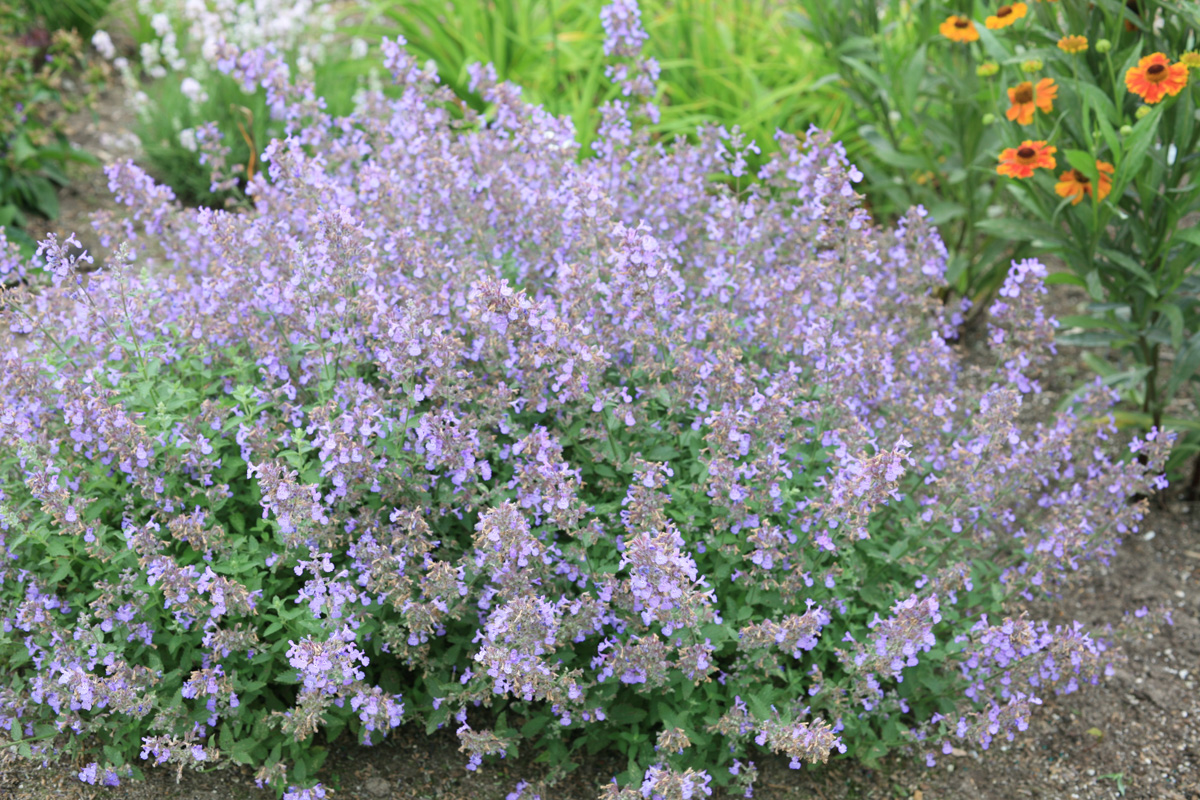
Junior Walker™ is shorter than its parent ‘Walker’s Low’ but has the same violet colored mint-like flowers with long lasting color. During May this begins with a giant color burst, then tapers off but continues sporadically throughout the summer and early fall, and more so if trimmed back. Junior Walker™, because of its mounding habit, is well suited as a ground cover or mixed border planting. And since it spreads to 2′ across, it takes only a few plants to create a nice mass. It is well behaved too and will not flop over or reseed. For a colorful low-maintenance planting, combine Junior Walker™ with numerous companions.

Details

Hardiness Zone:

5

Blossom Color:

Violet to Purple

Growth Habit:

Sprawling

Max Height:

1½'

Texture:

Fine Texture

Recommended Spacing:

2' to 2½'

We sell this plant in these containers:
#1 Pot
#1 Pot

Special Characteristics

True
Cuttings
True
Seasonal Effect
True
Moderate Area
True
Salt Tolerant
True
Drought Tolerant
True
Hummingbird
True
Butterflies
True
Bees
True
Large Area
True
Small Area
True
Deer Resistant
True
Fragrant Flowers
True
Rebloomer

Features

Shorter than its parent 'Walker's Low' but has the same violet colored mint-like flowers with long lasting color.

Landscape Value

Well suited as a ground cover or mixed border planting.

Care

Watering:

Junior Walker™ Nepeta is moderately drought tolerant but benefits from occasional watering, to maintain soil in a moist but not wet condition, during the summer months.

Fertilizing:

Junior Walker™ Nepeta is a moderate feeder, benefiting from a couple of annual applications of slow release fertilizer. A spring application of a 3-1-2 ratio (such as a 15-5-10) can be applied at a rate of about 10 pounds per 1000 square feet, and during early fall, an application of a 2-1-2 ratio (such as a 10-5-10) can be applied to encourage root development and cold hardiness.

Pruning:

Junior Walker™ Nepeta should be enjoyed all winter long, then, during early April before it begins to grow again, it should be pruned or mowed back to ground level.

Companion Plants

Miscanthus sinensis ‘Morning Light’View
Japanese Silver Grass, `Morning Light'
Sedum Strawberry Fluff™ (`Nonfful’)View
Sedum, Strawberry Fluff™
Rudbeckia fulgida var. sullivantii ‘Goldsturm’View
Coneflower, Orange, `Goldsturm'
Rudbeckia x ‘Glitters Like Gold’ PP30,933View
Coneflower, Orange, `Glitters Like Gold'
Rudbeckia speciosa ‘Viette’s Little Suzy’View
Coneflower, Orange, `Little Suzy' Dwarf
Rudbeckia fulgida var. sullivantii ‘Little Goldstar’View
Coneflower, Orange, `Little Goldstar' Dwarf
Sedum ‘Thunderhead’ PP24,693View
Sedum, `Thunderhead'
Sedum ‘Powderpuff’ PP32,714View
Sedum, `Powderpuff'
Sedum ‘Carl’View
Sedum, `Carl'
Sedum ‘Autumn Fire’ PPAFView
Sedum, `Autumn Fire'
Sedum ‘Autumn Joy’View
Sedum, `Autumn Joy'
Hemerocallis ‘Passion for Red’View
Daylily, `Passion for Red'
Hemerocallis ‘Primal Scream’View
Daylily, `Primal Scream'
Hemerocallis ‘Rocket City’View
Daylily, `Rocket City'
Hemerocallis ‘Ruby Spider’View
Daylily, `Ruby Spider'
Hemerocallis ‘Stella de Oro’View
Daylily, `Stella de Oro'
Hemerocallis ‘Stella Supreme’View
Daylily, `Stella Supreme'
Miscanthus sinensis ‘Graziella’View
Japanese Silver Grass, `Graziella' [Grace]
Miscanthus sinensis ‘Gracillimus’View
Japanese Silver Grass, Narrow Leaved
Miscanthus sinensis ‘Gold Breeze’ PP22,311View
Zebra Grass, `Gold Breeze'
Miscanthus sinensis ‘Malepartus’View
Japanese Silver Grass, `Malepartus'
Pennisetum alopecuroides ‘Ginger Love’ PP26,442View
Fountain Grass, `Ginger Love'
Pennisetum alopecuroides ‘Lumen Gold’ PP27,435View
Fountain Grass, `Lumen Gold'
Pennisetum alopecuroides Fuzzy Wuzzy® PPAF (‘Nonyzz’)View
Fountain Grass, Fuzzy Wuzzy®
Pennisetum alopecuroides Hush Puppy™View
Fountain Grass, Hush Puppy™
Pennisetum alopecuroides Jambalaya™ PP31,176View
Fountain Grass, Jambalaya