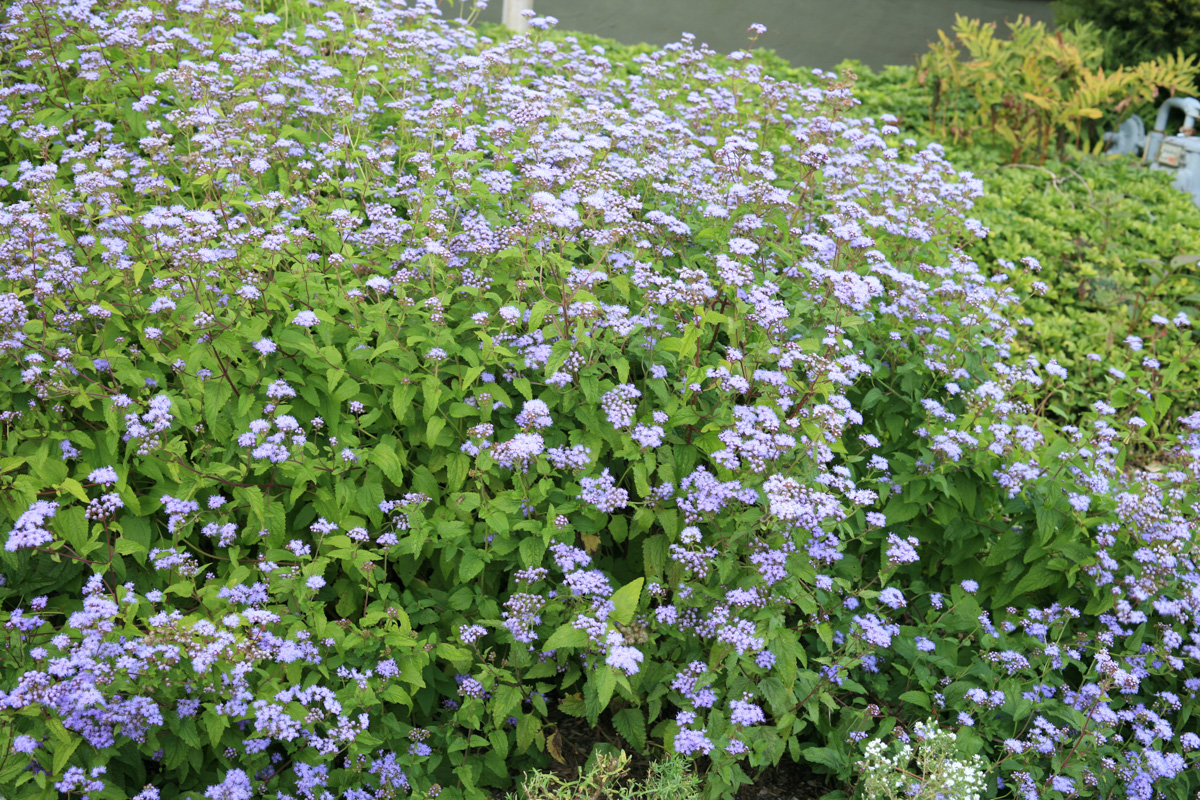
Eupatorium coelestinum

Blooming Time

August
September
October

Exposure

True
Full Sun
True
Light Shade

Blue mistflower, or hardy ageratum, is a rugged yet pretty native with slow creeping shrub-like habit, red stems, bright green leaves, and masses of fuzzy, bright blue, late-season flowers. It is good for cutting, butterfly attracting extraordinaire, and in the landscape its true blue flowers help to make it a superior companion to numerous perennials. Hardy ageratum is adaptable to a range of soils from dry and gravelly to moist and organically rich, and light conditions from full sun to moderate shade. Combined, these attributes make it an excellent choice for the naturalized garden and an exceptional choice for bio-swales and rain gardens.

Details

Hardiness Zone:

5

Blossom Color:

Blue to Blue Gray

Growth Habit:

Slow Spreading

Max Height:

2½'

Texture:

Medium Texture

Recommended Spacing:

2' to 2½'

We sell this plant in these containers:

#1 Pot
#1 Pot

Special Characteristics

True
Cuttings
True
Moderate Area
True
Butterflies
True
Bees
True
Large Area
True
Deer Resistant
True
Sandy Soil Tolerant
Controls Erosion
True
Moisture Tolerant
True
Native Species

Features

Great for cutting, butterfly attracting extraordinaire, and the true blue flowers help to make it a superior companion.

Landscape Value

An excellent choice for the naturalized garden and an exceptional choice for bio-swales and rain gardens.

Care

Watering:

Blue Mistflower requires a fair amount of supplemental watering and often requires watering on a regular basis during the growing season.

Fertilizing:

Blue Mistflower is a moderate feeder, benefiting from a couple of annual applications of slow release fertilizer. A spring application of a 3-1-2 ratio (such as a 15-5-10) can be applied at a rate of about 10 pounds per 1000 square feet, and during early fall, an application of a 2-1-2 ratio (such as a 10-5-10) can be applied to encourage root development and cold hardiness.

Pruning:

Blue Mistflower should be enjoyed all winter long, then, during early April before it begins to grow again, it should be pruned or mowed back to ground level.

Companion Plants

Schizachyrium scoparium ‘The Blues’View
Bluestem, Little, `The Blues'
Panicum virgatum ‘Heavy Metal’View
Switch Grass, `Heavy Metal'
Andropogon gerardii Prairie Proud® Karl’s Cousin® (`Nondhwr’)View
Bluestem, Big, Karl's Cousin®
Andropogon gerardii ‘Blackhawks’ PP27,949View
Bluestem, Big, `Blackhawks'
Andropogon gerardii ‘Dancing Wind’ PP23,892View
Bluestem, Big, `Dancing Wind'
Andropogon gerardii ‘Holy Smoke’ PP33,929View
Bluestem, Big, `Holy Smoke'
Andropogon gerardii `Red October’ PP26,283View
Bluestem, Big, `Red October'
Rudbeckia x ‘Glitters Like Gold’ PP30,933View
Coneflower, Orange, `Glitters Like Gold'
Rudbeckia fulgida var. deamiiView
Coneflower, Orange, Deam's
Rudbeckia fulgida var. sullivantii ‘Little Goldstar’View
Coneflower, Orange, `Little Goldstar' Dwarf
Rudbeckia ‘American Gold Rush’ PP28,498View
Coneflower, Orange, `American Gold Rush'
Echinacea ‘Sweet Sandia’ PPAFView
Coneflower, `Sweet Sandia'
Echinacea Cara Mia™ Yellow PP31,142View
Coneflower, Cara Mia™ Yellow
Echinacea ‘Cheyenne Spirit’View
Coneflower, `Cheyenne Spirit'
Echinacea Crazy Pink™ PP21,023View
Coneflower, `Crazy Pink'
Echinacea Dark Shadows™ ‘Wicked’ PPAFView
Coneflower, Dark Shadows™ `Wicked'
Echinacea ‘Delicious Candy’ PP24,329View
Coneflower, `Delicious Candy'
Echinacea Fine Feathered™ Parrot PPAFView
Coneflower, Fine Feathered™ Parrot
Panicum virgatum Dream Catcher® Smoky Rose® (‘Nonesory’) PP36,511View
Switch Grass, Smoky Rose®
Panicum virgatum Dream Catcher® Tumbleweed® (‘Nondee’) PP36,232View
Switch Grass, Tumbleweed®
Panicum virgatum Dream Catcher® Lightning Bolt® (‘Nontlobg’) PP36,395View
Switch Grass, Lightning Bolt®
Panicum virgatum ‘Shenandoah’View
Switch Grass, `Shenandoah'
Sorghastrum nutans Golden Sunset® PP33,776View
Indian Grass, Golden Sunset®