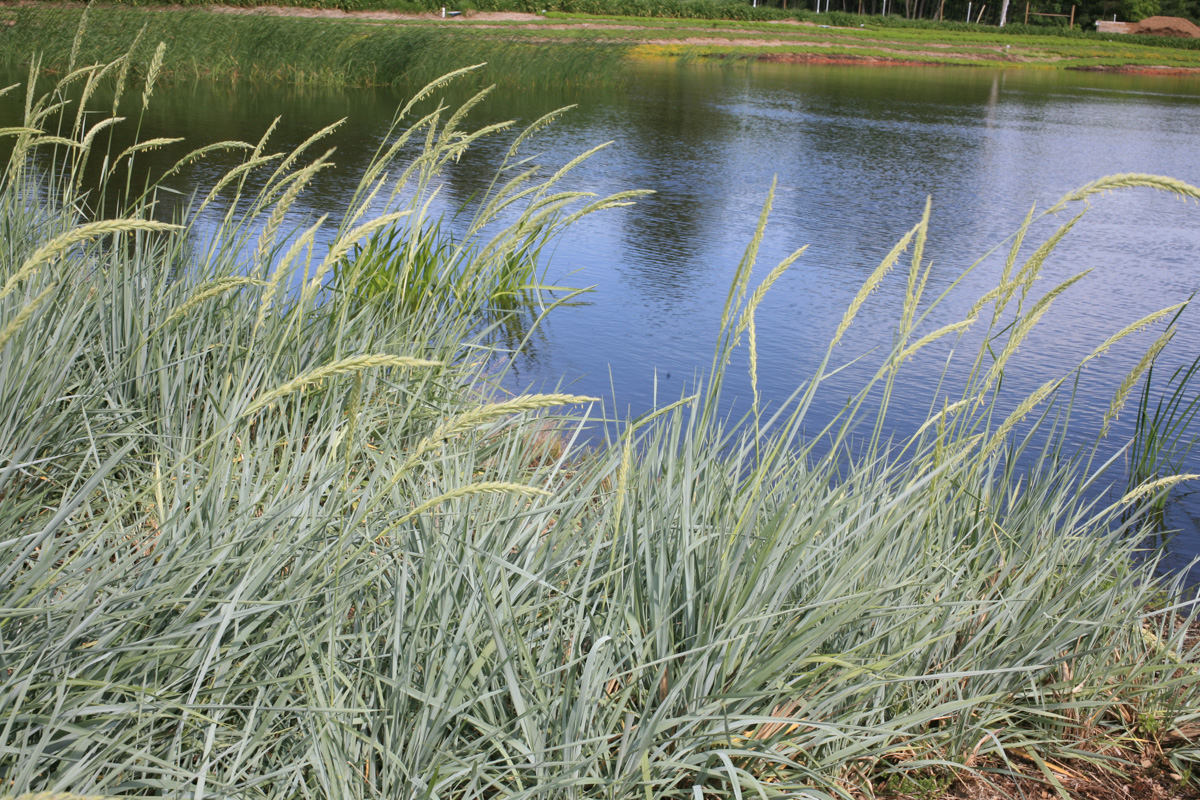
Leymus arenarius ‘Blue Dune’

Blooming Time

July
August

Exposure

True
Full Sun
True
Light Shade

Of the brightest blue grasses, `Blue Dune’ is even brighter then the parent species (formerly known as Elymus glaucus). Also, it is slower spreading, although it does spread and should be contained unless one wishes for it to cover a large area. During early summer, it sends up many interesting blue green flower stalks. `Blue Dune’ is excellent in parking areas where it tolerates heat and drought, and it will grow in pure sand as an excellent alternative to our native beach grasses. `Blue Dune’ is easy to care for and reliable for many years.

Details

Hardiness Zone:

4

Blossom Color:

Tan to Brown

Growth Habit:

Slow Spreading

Max Height:

3'

Texture:

Coarse Texture

Recommended Spacing:

12" to 16"

We sell this plant in these containers:

#1 Pot
#1 Pot

Special Characteristics

True
Cuttings
True
Seasonal Effect
True
Moderate Area
True
Salt Tolerant
True
Drought Tolerant
True
Large Area
True
Deer Resistant
True
Sandy Soil Tolerant
Controls Erosion

Features

Interesting spreading grass with leaves unrivaled in their blueness, blue green flower stalks in early summer.

Landscape Value

Bright color contrast, spreading habit, excellent contained or mass planted as a large-scale ground cover.

Care

Watering:

'Blue Dune' Wild Rye is moderately drought tolerant but benefits from occasional watering, to maintain soil in a moist but not wet condition, during the summer months.

Fertilizing:

'Blue Dune' Wild Rye is a moderate feeder, benefiting from a couple of annual applications of slow release fertilizer. A spring application of a 3-1-2 ratio (such as a 15-5-10) can be applied at a rate of about 10 pounds per 1000 square feet, and during early fall, an application of a 2-1-2 ratio (such as a 10-5-10) can be applied to encourage root development and cold hardiness.

Pruning:

'Blue Dune' Wild Rye should be enjoyed all winter long, then, during early April before it begins to grow again, it should be pruned or mowed back to ground level.

Companion Plants

Miscanthus sinensis ‘Encore’ PP29,070View
Maiden Grass, `Encore
Calamagrostis x acutiflora `Overdam’View
Feather Reed Grass, Variegated
Hemerocallis ‘Ruby Spider’View
Daylily, `Ruby Spider'
Digitalis purpurea ‘Candy Mountain’View
Foxglove, `Candy Mountain'
Calamagrostis x acutiflora ‘Karl Foerster’View
Feather Reed Grass, Karl Foerster's
Calamagrostis arundinacea var. brachytrichaView
Feather Reed Grass, Fall Blooming
Hemerocallis ‘Primal Scream’View
Daylily, `Primal Scream'
Hemerocallis ‘Passion for Red’View
Daylily, `Passion for Red'
Hibiscus moscheutos `Midnight Marvel’ PP24,079View
Hibiscus, `Midnight Marvel'
Hibiscus ‘Starry Starry Night’ PP27,901View
Mallow, Hardy, `Starry Starry Night'
Digitalis purpurea ‘Dalmatian Peach’View
Foxglove, `Dalmatian Peach'
Digitalis purpurea Arctic Fox Rose PP31,900View
Foxglove, Arctic Fox Rose
Echinacea ‘Fragrant Angel’View
Coneflower, `Fragrant Angel'
Echinacea Dark Shadows™ ‘Wicked’ PPAFView
Coneflower, Dark Shadows™ `Wicked'
Echinacea Crazy Pink™ PP21,023View
Coneflower, `Crazy Pink'
Echinacea ‘Orange Skipper’ PPAFView
Coneflower, `Orange Skipper'
Echinacea Kismet® White PP30,856View
Coneflower, Kismet® White
Echinacea Kismet® Raspberry PP28,768View
Coneflower, Kismet® Raspberry
Echinacea ‘PowWow Wildberry’ PPAFView
Coneflower, `PowWow Wildberry'
Miscanthus sinensis ‘Morning Light’View
Japanese Silver Grass, `Morning Light'
Miscanthus sinensis ‘Strictus’View
Japanese Silver Grass, Porcupine
Miscanthus sinensis ‘Tiger Tail’ PP21,788View
Maiden Grass, `Tiger Tail'
Miscanthus sinensis ‘Grosse Fontane’View
Japanese Silver Grass, Giant Fountain
Miscanthus sinensis ‘Malepartus’View
Japanese Silver Grass, `Malepartus'
Miscanthus sinensis ‘Little Kitten’View
Japanese Silver Grass, `Little Kitten'
Miscanthus sinensis ‘Purpurascens’View
Japanese Silver Grass, Flame
Aster oblongifolius ‘October Skies’View
Aster, Aromatic, `October Skies'
Aster novae-angliae ‘Grape Crush’ PP33,612View
Aster, New England, `Grape Crush'
Aster ‘Wood’s Light Blue’View
Aster, `Wood's Light Blue'