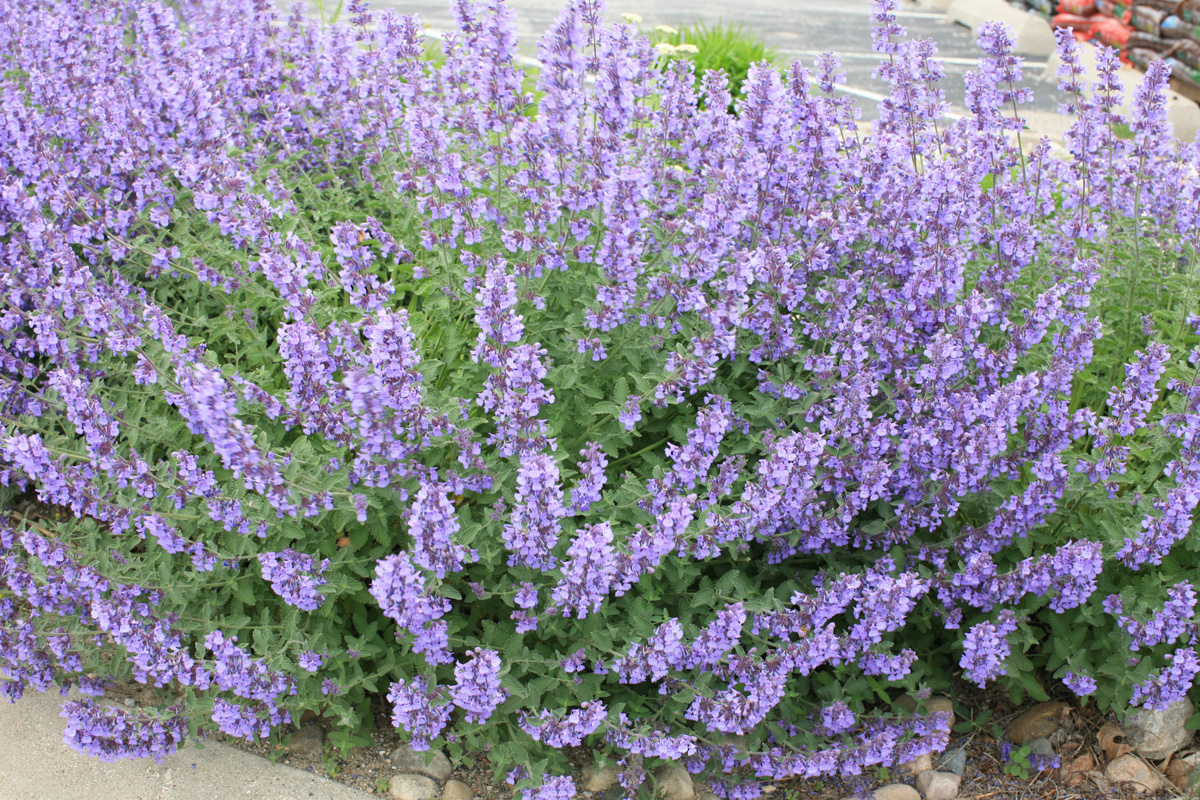
Nepeta x faassenii ‘Walker’s Low’

Blooming Time

April
May
June
July
August
September

Exposure

True
Full Sun
True
Light Shade

The name may be a bit of a misnomer but this fragrant leaved sprawling /mounding selection is perfect for moderate to large scale ground covering applications as well as accent and companion planting. ‘Walker’s Low’ is quickly becoming popular for its exceptional long blooming season in which it is decorated with a profusion of lavender-blue trumpet shaped flowers from April through fall. Try it alone or in combination with companions. Either way, you are in for a low maintenance, rewarding, colorful gardening experience. 2007 Perennial Plant of the Year.

Details

Hardiness Zone:

3

Blossom Color:

Blue to Blue Gray

Growth Habit:

Sprawling

Max Height:

2'

Texture:

Fine Texture

Recommended Spacing:

2' to 3'

We sell this plant in these containers:
#1 Pot
#1 Pot

Special Characteristics

True
Cuttings
True
Seasonal Effect
True
Moderate Area
True
Salt Tolerant
True
Drought Tolerant
True
Hummingbird
True
Butterflies
True
Bees
True
Large Area
True
Small Area
True
Deer Resistant
True
Rebloomer
True
Award Winning

Features

Dark blue hummingbird attracting flowers on 6-inch tall spikes mid summer and early fall nearly obscure pleasantly aromatic gray green heart-leaves.

Landscape Value

Moderate to large scale ground cover, accent, edging, specimen, or companion.

Care

Watering:

'Walker's Low' Hybrid Nepeta is moderately drought tolerant but benefits from occasional watering, to maintain soil in a moist but not wet condition, during the summer months.

Fertilizing:

'Walker's Low' Hybrid Nepeta is a moderate feeder, benefiting from a couple of annual applications of slow release fertilizer. A spring application of a 3-1-2 ratio (such as a 15-5-10) can be applied at a rate of about 10 pounds per 1000 square feet, and during early fall, an application of a 2-1-2 ratio (such as a 10-5-10) can be applied to encourage root development and cold hardiness.

Pruning:

'Walker's Low' Hybrid Nepeta should be enjoyed all winter long, then, during early April before it begins to grow again, it should be pruned or mowed back to ground level.

Companion Plants

Pennisetum alopecuroides ‘Hameln’View
Fountain Grass, `Hameln' Dwarf
Sedum Sunsparkler® Plum Dazzled PP30,348View
Sedum, Sunsparkler® Plum Dazzled
Rudbeckia fulgida var. deamiiView
Coneflower, Orange, Deam's
Coreopsis Li’l Bang™ ‘Enchanted Eve’ PP27,857View
Coreopsis, `Enchanted Eve'
Allium Glitterbug® All A’ Flutter (`Nonrettu’)View
Ornamental Chive, All A' Flutter
Allium Glitterbug® Bee’s Knees® (`Nonseenk’)View
Ornamental Chive, Bee's Knees®
Allium ‘Windy City’ PP28,100View
Ornamental Chive, `Windy City'
Allium Glitterbug® Humble Bumble® (`Nonelbmu’)View
Ornamental Chive, Humble Bumble®
Allium ‘Millenium’View
Ornamental Chive, `Millenium'
Coreopsis Leading Lady ‘Lauren’ PPAFView
Coreopsis, Leading Lady `Lauren'
Coreopsis ‘Red Satin’ PP25,736View
Coreopsis, `Red Satin'
Coreopsis ‘Citrine’ PP22,470View
Coreopsis, `Citrine'
Coreopsis Li’l Bang™ ‘Darling Clementine’ PP31,843View
Coreopsis, Li'l Bang™ `Darling Clementine'
Pennisetum alopecuroides Hush Puppy™View
Fountain Grass, Hush Puppy™
Pennisetum alopecuroides ‘Red Head’View
Fountain Grass, `Red Head'
Pennisetum alopecuroides ‘Moudry’View
Fountain Grass, Black Flowered
Pennisetum alopecuroides ‘Ginger Love’ PP26,442View
Fountain Grass, `Ginger Love'
Pennisetum alopecuroides Fuzzy Wuzzy® PPAF (‘Nonyzz’)View
Fountain Grass, Fuzzy Wuzzy®
Pennisetum alopecuroides ‘Lumen Gold’ PP27,435View
Fountain Grass, `Lumen Gold'
Rudbeckia x ‘Glitters Like Gold’ PP30,933View
Coneflower, Orange, `Glitters Like Gold'
Rudbeckia ‘American Gold Rush’ PP28,498View
Coneflower, Orange, `American Gold Rush'
Rudbeckia fulgida var. sullivantii ‘Little Goldstar’View
Coneflower, Orange, `Little Goldstar' Dwarf
Rudbeckia fulgida var. sullivantii ‘Goldsturm’View
Coneflower, Orange, `Goldsturm'