
Ligularia ‘Little Golden Ray’ PP31,911
Blooming Time
Exposure


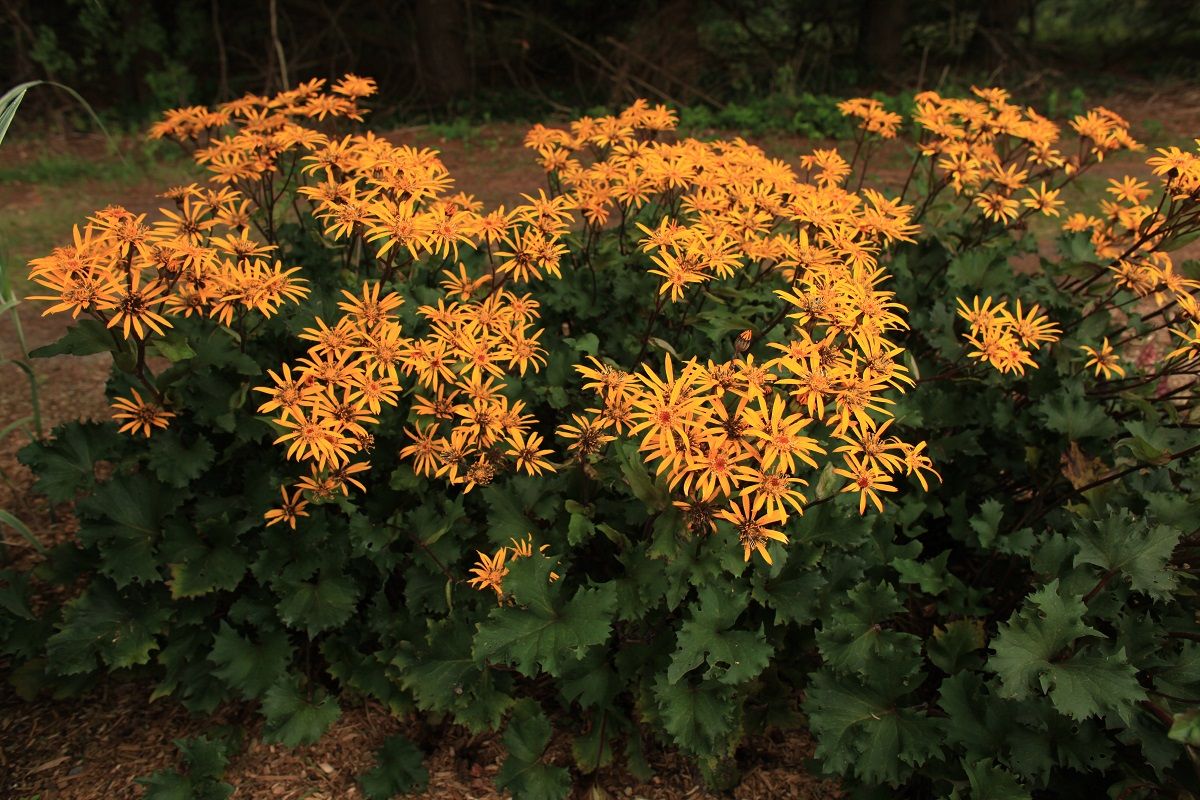
A compact, yet remarkable foliage plant, `Little Golden Ray’ is smaller than most Ligularias, forming well mannered clumps of ruffled, heart-shaped foliage in shades of rich olive-green and highlighted with deep purple. In early to mid-summer `Little Golden Ray’ sends up cheerful sprigs of yellow daisy-like flowers that bloom just above the foliage on thick purple stems. At home in damp, organically rich soils, `Little Golden Ray’ is great for moist boggy areas or shady pond edges.
Details
Hardiness Zone:
Blossom Color:
Yellow to Chartreuse
Growth Habit:
Clump Forming
Max Height:
1½'
Texture:
Recommended Spacing:
We sell this plant in these containers:
Special Characteristics








Features
Ruffled, heart-shaped foliage in shades of rich olive-green and highlighted with deep purple, in early to mid-summer `Little Golden Ray' sends up cheerful sprigs of yellow daisy-like flowers.
Landscape Value
At home in damp, organically rich soils, `Little Golden Ray' is great for moist boggy areas or shady pond edges.
Care
Watering:
`Little Golden Ray' Ligularia requires a fair amount of supplemental watering and often requires watering on a regular basis during the growing season.
Fertilizing:
`Little Golden Ray' Ligularia is a moderate feeder, benefiting from a couple of annual applications of slow release fertilizer. A spring application of a 3-1-2 ratio (such as a 15-5-10) can be applied at a rate of about 10 pounds per 1000 square feet, and during early fall, an application of a 2-1-2 ratio (such as a 10-5-10) can be applied to encourage root development and cold hardiness.
Pruning:
`Little Golden Ray' Ligularia is a deciduous plant (nonevergreen) and does not require pruning. It is perfectly acceptable to allow the dropped leaves to decompose and nourish the soil.