
Solidago rugosa ‘Fireworks’
Blooming Time
Exposure

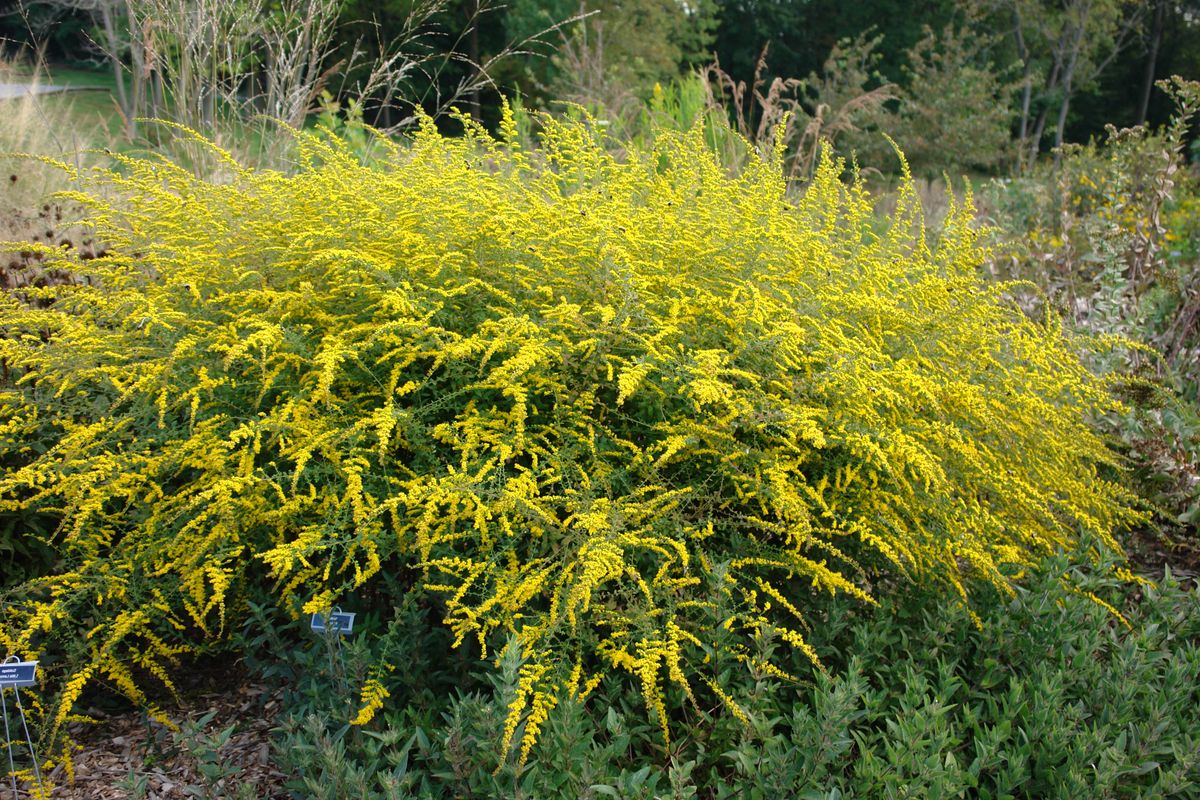
‘Fireworks’ was the top overall choice among many goldenrods evaluated by the Chicago Botanic Garden, and it is valued by landscape designers for its interesting form and magnificent late-season flowers. It has a shrubby habit with tight groups of arching stems with finely textured leaves that emerge burgundy before changing to dark green. But that’s nothing compared to the explosion (i.e. fireworks) of intensely yellow flower panicles during late summer and fall. ‘Fireworks’ tolerates moister soils than other goldenrods and is a phenomenal attractor of butterflies (especially Monarchs), bees, and other pollinators. It is an effective specimen and combines effectively with companions.
Details
Hardiness Zone:
Blossom Color:
Yellow to Chartreuse
Growth Habit:
Shrubby
Max Height:
4'
Texture:
Recommended Spacing:
We sell this plant in these containers:
Special Characteristics










Features
Has an interesting form and magnificent late-season flowers with a shrubby habit and tight groups of arching stems with finely textured leaves that emerge burgundy before changing to dark green.
Landscape Value
Can be used to help naturalize an area, as a gorgeous specimen, grown en masse, or as a companion.
Care
Watering:
'Fireworks' Goldenrod is moderately drought tolerant but benefits from occasional watering, to maintain soil in a moist but not wet condition, during the summer months.
Fertilizing:
'Fireworks' Goldenrod needs little fertilizer, but benefits from a single springtime or fall topdressing (about 1 inch deep) of organic compost or well rotted leaves. Alternatively, a springtime application of a slow release fertilizer with a 3-1-2 ratio (such as a 15-5-10) can be applied at a rate of about 10 pounds per 1000 square feet.
Pruning:
'Fireworks' Goldenrod should be enjoyed all winter long, then, during early April before it begins to grow again, it should be pruned or mowed back to ground level.