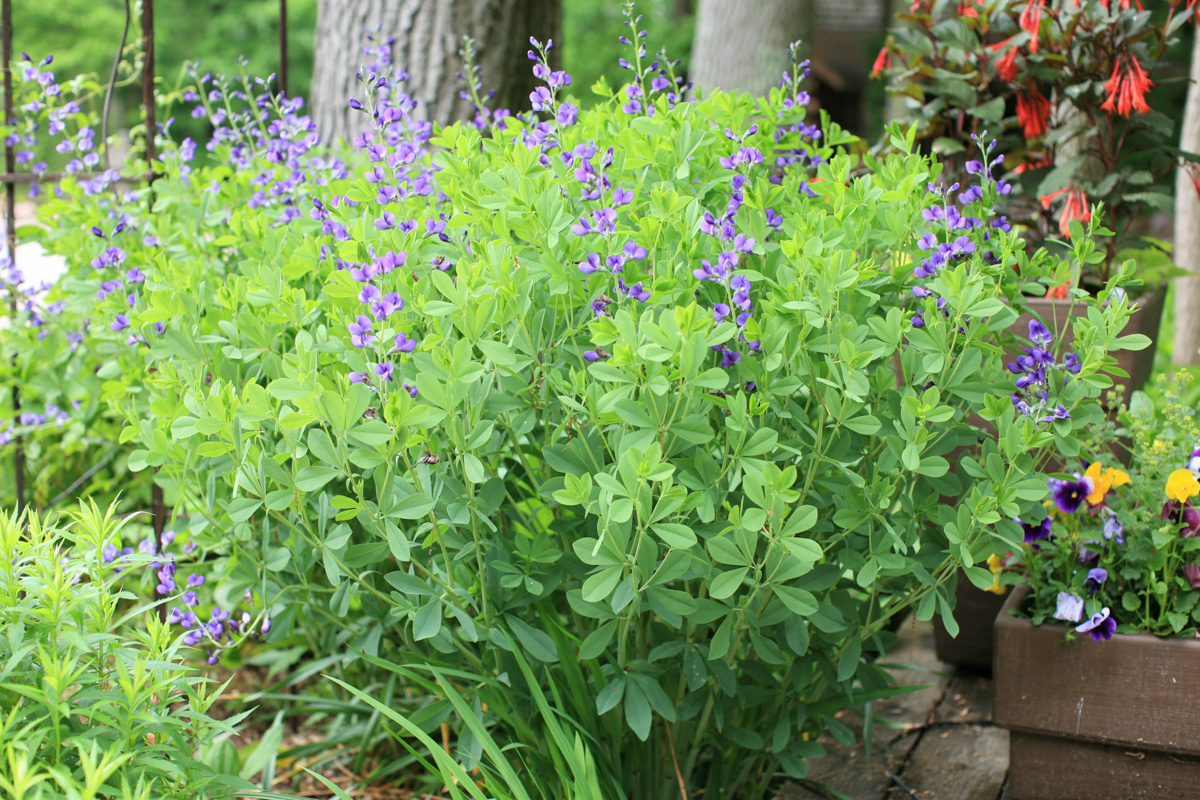
Native to the eastern United States, blue false indigo is an upright shrubby perennial once used by Native Americans for making blue dye. While slow growing at first, once established it develops into robust clumps with vase-like upright habit. It is durable and drought tolerant and clothed in blue-green clover shaped trifoliate leaves. During spring and early summer it bears a multitude of iridescent blue, lupine-like flowers upon erect flower spikes well above the foliar mass. Flowers eventually give way to interesting pea-like pods which hold up well in dried flower arrangements. 2010 Perennial Plant of the Year.
×
Quantity Calculator
Details
Hardiness Zone:
3
Blossom Color:
Blue to Blue Gray
Growth Habit:
Shrubby
Max Height:
4'
Texture:
Medium Texture
Recommended Spacing:
4' to 4½'
We sell this plant in these containers:
#2 Pot
Special Characteristics
Cuttings
Moderate Area
Salt Tolerant
Drought Tolerant
Butterflies
Bees
Large Area
Deer Resistant
Sandy Soil Tolerant
Controls Erosion
Native Species
Award Winning
Features
An upright shrubby perennial that develops into robust clumps with vase-like upright habit. During spring and early summer it bears a multitude of iridescent blue, lupine-like flowers.
Landscape Value
It is durable and drought tolerant, and clothed in blue-green clover shaped trifoliate leaves.
Care
Watering:
Blue False Indigo is very drought tolerant and typically only needs watering during the hottest days of summer.
Fertilizing:
Blue False Indigo needs little fertilizer, but benefits from a single springtime or fall topdressing (about 1 inch deep) of organic compost or well rotted leaves. Alternatively, a springtime application of a slow release fertilizer with a 3-1-2 ratio (such as a 15-5-10) can be applied at a rate of about 10 pounds per 1000 square feet.
Pruning:
Blue False Indigo sets its flower buds in summer, and any pruning should be conducted in April, immediately after winter.