
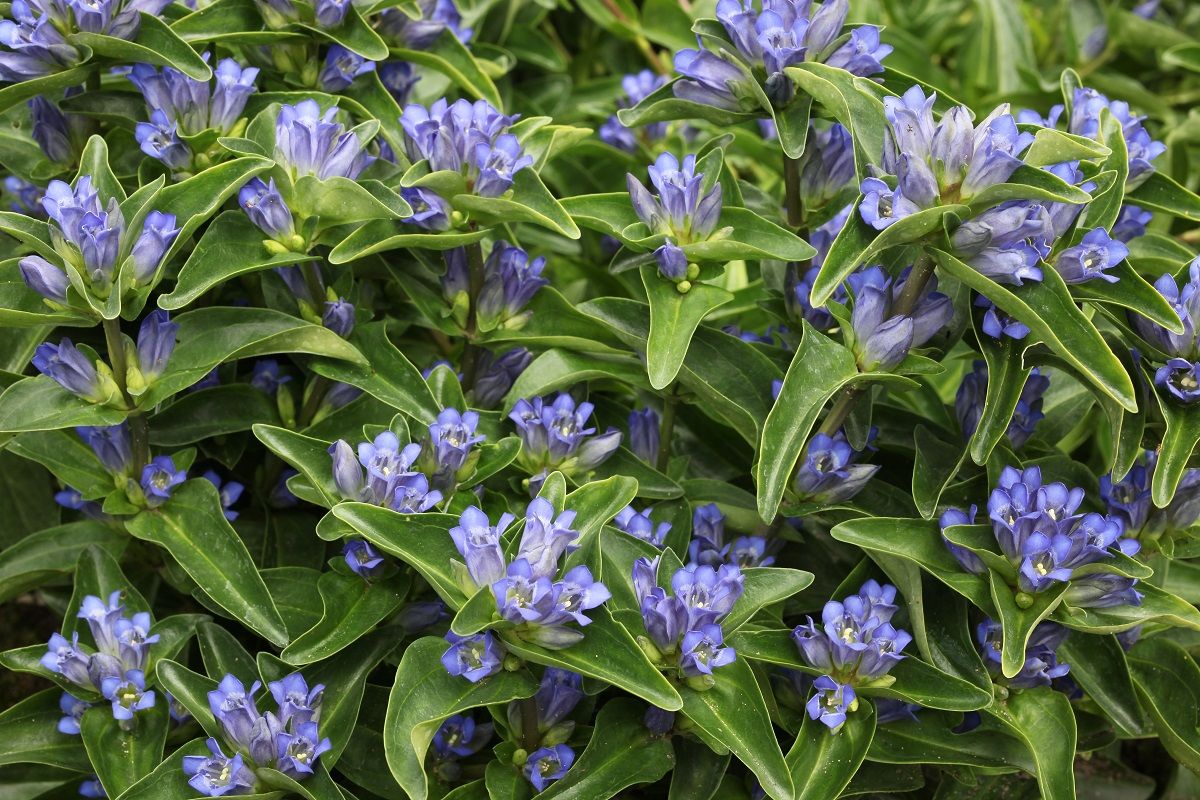
Gentiana cruciata

Blooming Time

June
July
August

Exposure

True
Full Sun
True
Light Shade

Cross Gentian has spoon shaped leaves that meet at the nodes in the form of a cross, hence the name. These leaves are thick, waxy, deep green, almost succulent, and set a beautiful foil to the loads of interesting flowers that this plant bears. The flowers are colored gentian-blue (of course) with white throats and arise mid to late summer. Shaped like trumpets, they are carried in clusters in the nodes of the stems and provide food to a host of pollinators. Considered easy to grow, Cross Gentiain is a great addition to most any garden.

Details

Hardiness Zone:

3

Blossom Color:

Blue to Blue Gray

Growth Habit:

Clump Forming

Max Height:

12"

Texture:

Medium Texture

Recommended Spacing:

12" to 1½'

We sell this plant in these containers:
#1 Pot
#1 Pot

Special Characteristics

True
Cuttings
True
Seasonal Effect
True
Moderate Area
True
Butterflies
True
Bees
True
Small Area

Features

Leaves are thick, waxy, deep green, almost succulent, and set a beautiful foil to the loads of interesting flowers that this plant bears.

Landscape Value

Considered easy to grow, Cross Gentiain is a great addition to most any garden.

Care

Watering:

Cross Gentian requires a fair amount of supplemental watering and often requires watering on a regular basis during the growing season.

Fertilizing:

Cross Gentian benefits from regular feeding and likely will grow best with: a spring (May) application of slow release fertilizer with a 3-1-2 ratio (such as a 15-5-10) at a rate of about 10 pounds per 1000 square feet, and a summer (July) application of slow release fertilizer with a 3-1-2 ratio (such as a 15-5-10) at a rate of about 10 pound per 1000 square feet, and and an early fall (September) application of a 2-1-2 ratio (such as a 10-5-10) at a rate of 15 pounds per 1000 square feet to encourage root development and cold hardiness.

Pruning:

Cross Gentian is a deciduous plant (nonevergreen) and does not require pruning. It is perfectly acceptable to allow the dropped leaves to decompose and nourish the soil.

Companion Plants

Digitalis purpurea ‘Dalmatian Peach’View
Foxglove, `Dalmatian Peach'
Digitalis purpurea ‘Candy Mountain’View
Foxglove, `Candy Mountain'
Digitalis purpurea Arctic Fox Rose PP31,900View
Foxglove, Arctic Fox Rose
Callirhoe involucrataView
Mallow, Poppy, Purple
Lobelia siphiliticaView
Great Blue Lobelia
Lobelia cardinalisView
Cardinal Flower
Lobelia speciosa ‘Starship Scarlet’View
Cardinal Flower, `Starship Scarlet'
Lobelia x speciosa ‘Starship Deep Rose’View
Cardinal Flower, `Starship Deep Rose'
Monarda didyma Pocahontas Red RoseView
Bee Balm, Pocahontas Red Rose
Monarda didyma ‘Purple Rooster’View
Bee Balm, `Purple Rooster'
Monarda didyma ‘Jacob Cline’View
Bee Balm, `Jacob Cline'
Monarda didyma Balmy Purple™ PP25,561View
Bee Balm, Balmy Purple™
Phlox ‘Forever Pink’ PP29,418View
Phlox, Garden, `Forever Pink'
Phlox paniculata ‘Red Riding Hood’View
Phlox, Garden, `Red Riding Hood'
Phlox paniculata ‘Laura’View
Phlox, Garden, `Laura'
Sedum ‘Carl’View
Sedum, `Carl'
Sedum spectabile Proud Mary™ (‘Nonyram’)View
Sedum, Proud Mary™
Sedum Sunsparkler® Plum Dazzled PP30,348View
Sedum, Sunsparkler® Plum Dazzled
Sedum Strawberry Fluff™ (`Nonfful’)View
Sedum, Strawberry Fluff™
Sesleria autumnalisView
Autumn Moor Grass
Rudbeckia fulgida var. sullivantii ‘Goldsturm’View
Coneflower, Orange, `Goldsturm'
Rudbeckia x ‘Glitters Like Gold’ PP30,933View
Coneflower, Orange, `Glitters Like Gold'
Rudbeckia fulgida var. sullivantii ‘Little Goldstar’View
Coneflower, Orange, `Little Goldstar' Dwarf
Rudbeckia ‘American Gold Rush’ PP28,498View
Coneflower, Orange, `American Gold Rush'
Festuca glauca ‘Beyond Blue’ PP23,307View
Fescue, Blue, `Beyond Blue'
Festuca glauca ‘Boulder Blue’View
Fescue, `Boulder Blue'