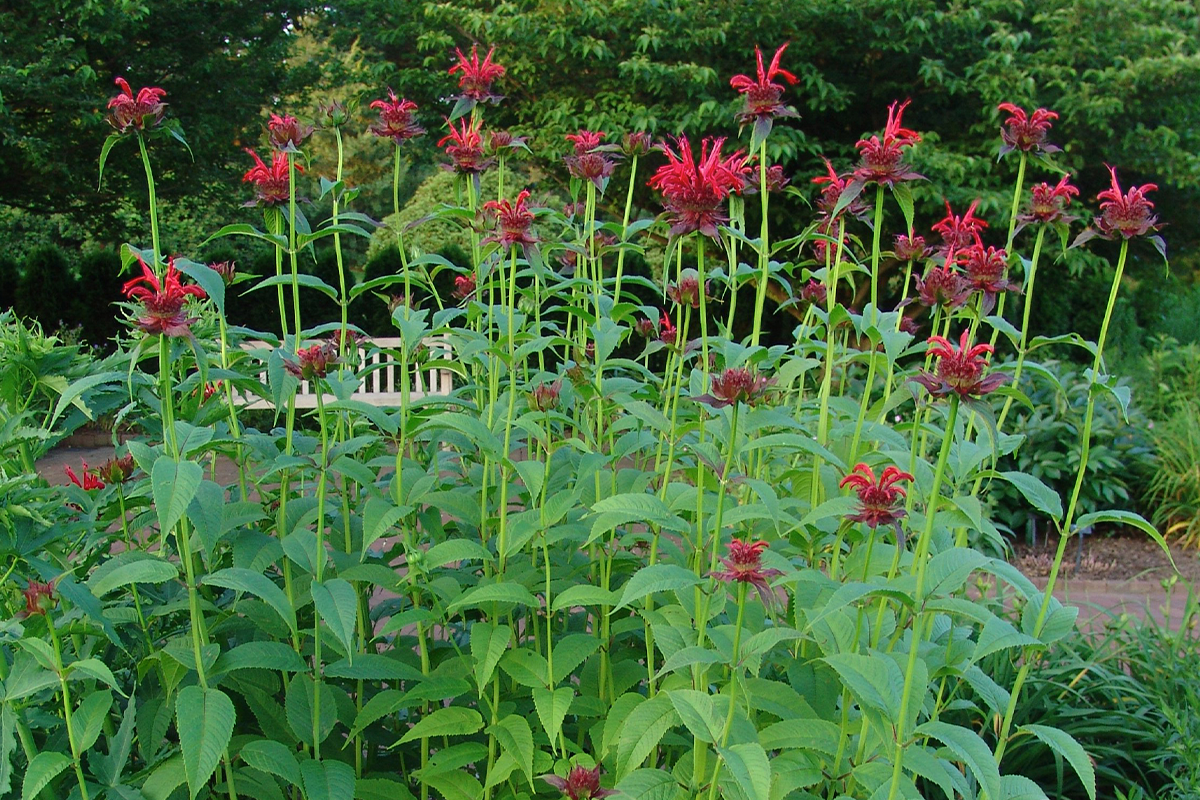
‘Jacob Cline’ is one of the best bee balms for attracting hummingbirds – proven by research at Mt. Cuba Center. There is something really appealing about its intensely red tubular flowers, which it bears in profuse quantities atop stiffly upright stems. Its foliage is mildew resistant and pleasantly aromatic, adding to its value in the garden and as a cut flower. ‘Jacob Cline’ is easily grown in an evenly moist soil.
×
Quantity Calculator
Details
Hardiness Zone:
4
Blossom Color:
Red
Growth Habit:
Slow Spreading
Max Height:
5'
Texture:
Medium Texture
Recommended Spacing:
14" to 1½'
We sell this plant in these containers:
#1 Pot
Special Characteristics
Cuttings
Seasonal Effect
Moderate Area
Hummingbird
Butterflies
Bees
Large Area
Deer Resistant
Sandy Soil Tolerant
Fragrant Flowers
Native Cultivar
Features
Known as one of the best bee balms for attracting hummingbirds - proven by research at Mt. Cuba Center.
Landscape Value
Its foliage is mildew resistant and pleasantly aromatic, adding to its value in the garden and as a cut flower on top of its value for pollinators.
Care
Watering:
'Jacob Cline' Bee Balm is moderately drought tolerant but benefits from occasional watering, to maintain soil in a moist but not wet condition, during the summer months.
Fertilizing:
'Jacob Cline' Bee Balm is a moderate feeder, benefiting from a couple of annual applications of slow release fertilizer. A spring application of a 3-1-2 ratio (such as a 15-5-10) can be applied at a rate of about 10 pounds per 1000 square feet, and during early fall, an application of a 2-1-2 ratio (such as a 10-5-10) can be applied to encourage root development and cold hardiness.
Pruning:
'Jacob Cline' Bee Balm should be enjoyed all winter long, then, during early April before it begins to grow again, it should be pruned or mowed back to ground level.