
Gillenia trifoliata (a.k.a. Porteranthus trifoliatus)
Blooming Time

May
June
July

Exposure

True
Light Shade
True
Moderate Shade
True
Dense Shade

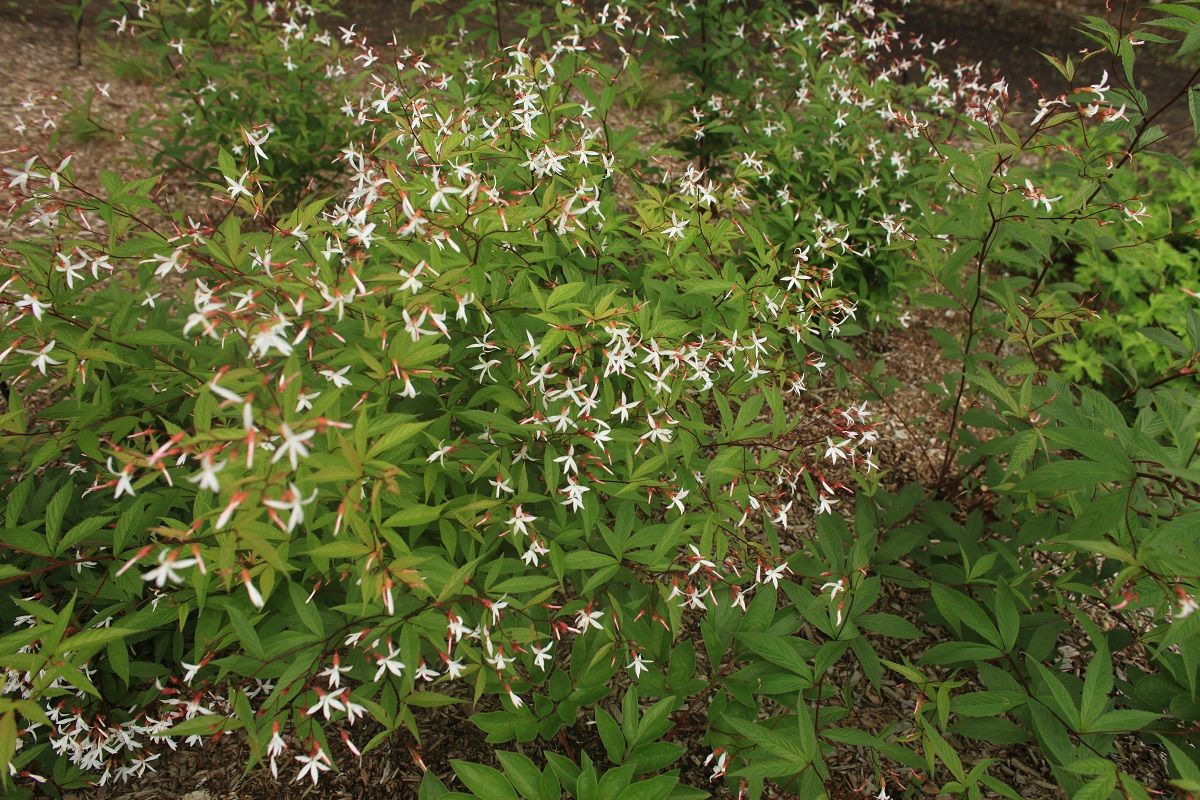
Relatively unknown, this low maintenance native species blooms in early spring, with masses of delicate, white, 5-petaled flowers that dance on slender burgundy stems. In summer its narrow, green, toothed foliage remains clean and disease free, forming airy, rounded mounds and turning a deep red-bronze in the fall. Bowman’s Root resembles Gaura- but very hardy, and is tolerant of moisture as well as drought once established, making it a versatile plant for use in an open garden or woodland border. Bowman’s root will even thrive with tree root competition if given a healthy layer of mulch.

Details

Hardiness Zone:

4

Blossom Color:

White to Cream

Growth Habit:

Sprawling

Max Height:

3'

Texture:

Fine Texture

Recommended Spacing:

2' to 2½'

We sell this plant in these containers:

#1 Pot
#1 Pot

Special Characteristics

True
Moderate Area
True
Drought Tolerant
True
Butterflies
True
Bees
True
Large Area
True
Sandy Soil Tolerant
True
Moisture Tolerant
True
Native Species

Features

Masses of delicate, white, 5-petaled flowers that dance on slender burgundy stems.

Landscape Value

A versatile plant for use in an open garden or woodland border. Bowman's root will even thrive with tree root competition if given a healthy layer of mulch.

Care

Watering:

Bowman's Root is moderately drought tolerant but benefits from occasional watering, to maintain soil in a moist but not wet condition, during the summer months.

Fertilizing:

Bowman's Root needs little fertilizer, but benefits from a single springtime or fall topdressing (about 1 inch deep) of organic compost or well rotted leaves. Alternatively, a springtime application of a slow release fertilizer with a 3-1-2 ratio (such as a 15-5-10) can be applied at a rate of about 10 pounds per 1000 square feet.

Pruning:

Bowman's Root should be enjoyed all winter long, then, during early April before it begins to grow again, it should be pruned or mowed back to ground level.

Companion Plants

Dryopteris marginalisView
Fern, Leatherleaf Woodfern
Dryopteris filix-mas ‘Barnesii’View
Fern, Male, Barne's
Dryopteris affinis ‘Stableri’View
Fern, Male, Golden-scaled, Stabler's
Matteuccia struthiopteris var. pennsylvanicaView
Fern, Ostrich
Heuchera ‘Georgia Peach’ PP19,375View
Coral Bells, `Georgia Peach'
Epimedium grandiflorum var. higoense ‘Bandit’View
Epimedium, `Bandit'
Epimedium warleyenseView
Epimedium, Orange Flowered
Epimedium x versicolor ‘Sulphureum’View
Epimedium, Yellow Flowered
Epimedium grandiflorum ‘Lilafee’View
Epimedium, Lilac Fairy
Helleborus ‘New York Night’View
Lenten Rose, `New York Night'
Helleborus FrostKiss® Molly’s White PP25,685View
Lenten Rose, Molly's White™
Helleborus Frost Kiss® Pippa’s Purple™ PP27,121View
Lenten Rose, 'Pippa's Purple'
Helleborus FrostKiss® Dorothy’s Dawn™ PP28,010View
Lenten Rose, Dorothy's Dawn™
Helleborus ‘Rome in Red’View
Lenten Rose, `Rome in Red'
Helleborus ‘Ivory Prince’View
Lenten Rose, `Ivory Prince'
Hosta ‘Guardian Angel’View
Hosta, `Guardian Angel'
Hosta ‘Liberty’View
Hosta, `Liberty'
Hosta ‘Lemon Frost’View
Hosta, Pocket, `Lemon Frost'
Hosta ‘Silly String’ PP32,127View
Hosta, `Silly String'
Hosta ‘Touch of Class’View
Hosta, `Touch of Class'
Polystichum polyblepharumView
Fern, Japanese Tassel
Pulmonaria ‘Trevi Fountain’View
Lungwort, `Trevi Fountain'
Pulmonaria ‘Dark Vader’View
Lungwort, `Dark Vader'
Pulmonaria ‘Raspberry Splash’View
Lungwort, `Raspberry Splash'
Carex oshimensis EverColor® ‘Everillo’ PP21,002View
Sedge, EverColor® `Everillo'
Carex hachijoensis ‘Evergold’View
Sedge, Japanese, `Evergold'
Carex morrowii ‘Ice Dance’View
Sedge, `Ice Dance'
Carex elata ‘Bowles Golden’View
Sedge, `Bowles Golden'
Carex Feather Falls™ PP26,199View
Sedge, Feather Falls™