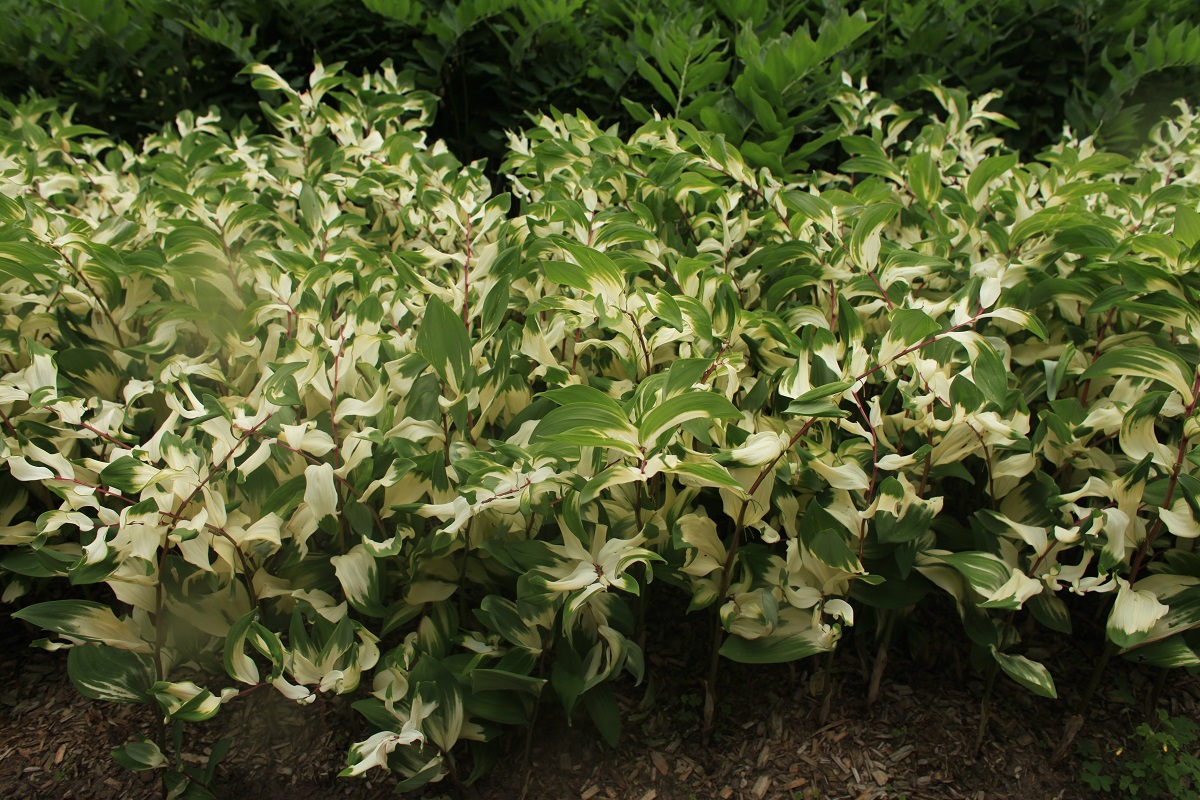
Polygonatum odoratum ‘Byakko’

Blooming Time

May

Exposure

True
Light Shade
True
Moderate Shade

A rare and stunning selection, ‘Byakko’s foliage begins as solid green, but soon becomes marked with blotches of creamy ivory white. These distinctive leaves are stacked alternately on arching, burgundy red stems and accented with waxy white bell-shaped flowers during spring. The variegation of ‘Byakko’ is unique and becomes more intense throughout the season. Byakko spreads slowly by horizontal rhizomes, like other Solomon’s seals, and it can be used en-masse as a stunning medium-to-large scale ground cover.

Details

Hardiness Zone:

4

Blossom Color:

White to Cream

Growth Habit:

Slow Spreading

Max Height:

2½'

Texture:

Medium Texture

Recommended Spacing:

12" to 16"

We sell this plant in these containers:

#1 Pot
#1 Pot

Special Characteristics

True
Cuttings
True
Seasonal Effect
True
Moderate Area
True
Drought Tolerant
True
Bees
True
Large Area
True
Small Area
True
Deer Resistant
Controls Erosion

Features

Distinctive leaves along red stems begin solid green, but soon become marked with blotches of creamy ivory. Waxy bell shaped flowers accent appear in spring.

Landscape Value

Spreading slowly by horizontal rhizomes, it can be used en-masse as a stunning medium-to-large-scale groundcover, it can also pair with numerous companions.

Care

Watering:

Byakko Solomon's Seal is moderately drought tolerant but benefits from occasional watering, to maintain soil in a moist but not wet condition, during the summer months.

Fertilizing:

Byakko Solomon's Seal is a moderate feeder, benefiting from a couple of annual applications of slow release fertilizer. A spring application of a 3-1-2 ratio (such as a 15-5-10) can be applied at a rate of about 10 pounds per 1000 square feet, and during early fall, an application of a 2-1-2 ratio (such as a 10-5-10) can be applied to encourage root development and cold hardiness.

Pruning:

Byakko Solomon's Seal is a deciduous plant (nonevergreen) and does not require pruning. It is perfectly acceptable to allow the dropped leaves to decompose and nourish the soil.

Companion Plants

Astilbe chinensis ‘Lowlands Ruby Red’View
Astilbe, `Lowlands Ruby Red'
Astilbe x arendsii Nemo®View
Astilbe, Nemo®
Epimedium grandiflorum var. higoense ‘Bandit’View
Epimedium, `Bandit'
Epimedium warleyenseView
Epimedium, Orange Flowered
Epimedium x ‘After Midnight’View
Epimedium, `After Midnight'
Hakonechloa macraView
Japanese Forest Grass
Hakonechloa macra ‘Albo-striata’View
Japanese Forest Grass, White Stripe
Hosta ‘Halcyon’View
Hosta, `Halcyon'
Hosta ‘Krossa Regal’View
Hosta, `Krossa Regal'
Hosta ‘Stained Glass’View
Hosta, `Stained Glass'
Ligularia dentata ‘Britt-Marie Crawford’View
Ligularia, `Britt-Marie Crawford' Big Leaf
Ligularia ‘Osiris Fantaisie’ PP19,302View
Ligularia, `Osiris Fantaisie'
Stylophorum diphyllumView
Celandine Poppy
Astilbe chinensis ‘Vision in Red’View
Astilbe, `Vision in Red'
Astilbe chinensis ‘Vision Inferno’ PP26,012View
Astilbe, `Vision Inferno'
Astilbe x japonica ‘Elizabeth van Veen’View
Astilbe, `Elizabeth van Veen'
Astilbe x japonica ‘Mainz’View
Astilbe, `Mainz'
Epimedium grandiflorum ‘Lilafee’View
Epimedium, Lilac Fairy
Epimedium x versicolor ‘Sulphureum’View
Epimedium, Yellow Flowered
Hosta ‘Liberty’View
Hosta, `Liberty'
Hosta ‘Praying Hands’View
Hosta, `Praying Hands'
Hosta ‘Sum and Substance’View
Hosta, `Sum and Substance'
Hosta ‘Touch of Class’View
Hosta, `Touch of Class'
Hosta ‘June’View
Hosta, `June'
Hosta ‘Guardian Angel’View
Hosta, `Guardian Angel'
Ligularia ‘Pandora’ PPAFView
Ligularia, `Pandora'
Ligularia ‘Little Golden Ray’ PP31,911View
Ligularia, `Little Golden Ray'
Ligularia dentata ‘Desdemona’View
Ligularia, Bigleaf
Ligularia stenocephala ‘Little Rocket’View
Ligularia, `Little Rocket'
Hakonechloa macra ‘All Gold’View
Japanese Forest Grass, `All Gold'
Hakonechloa macra ‘Aureola’View
Japanese Forest Grass, Golden-leaved