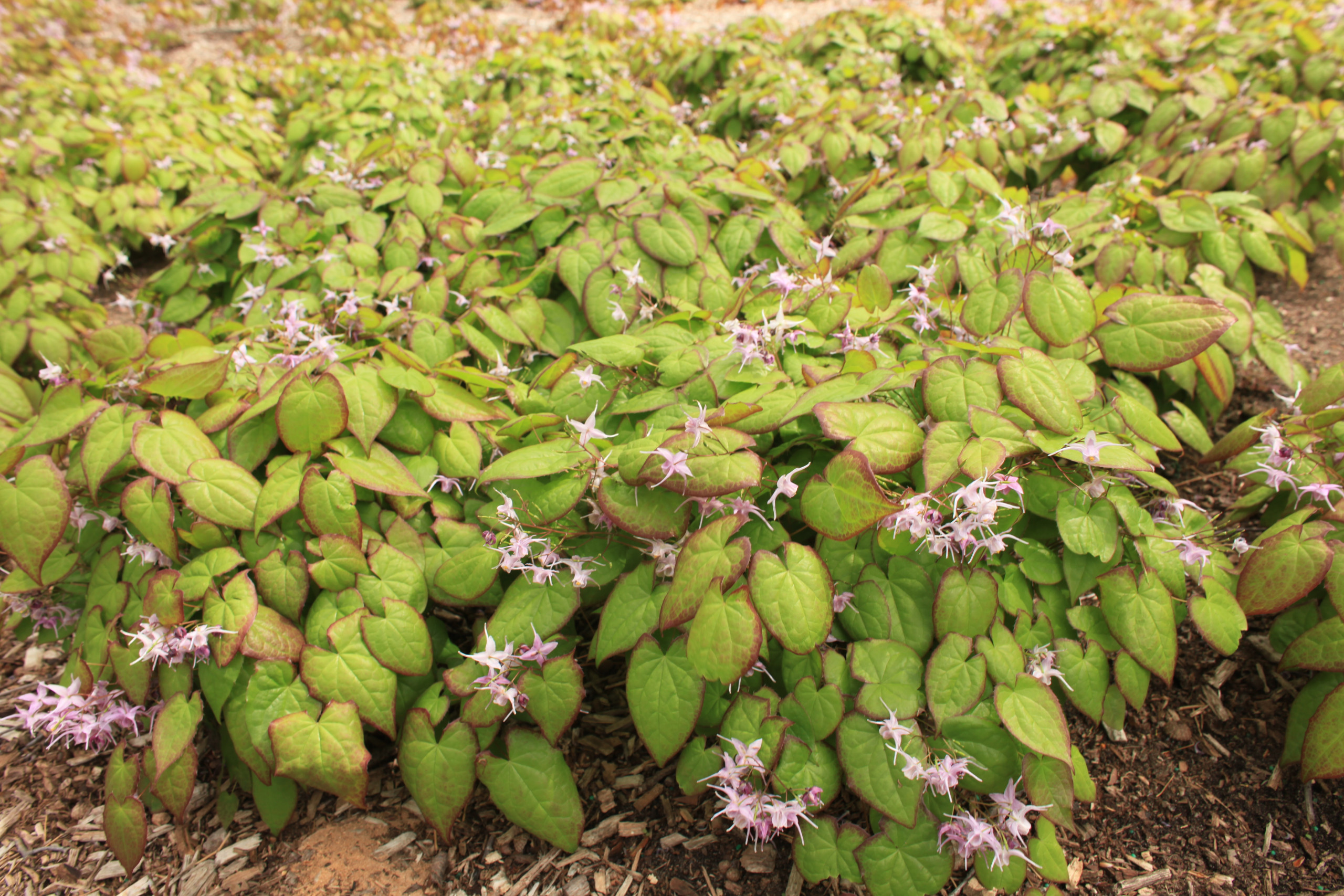
Epimedium grandiflorum ‘Queen Esta’

Blooming Time

April
May

Exposure

True
Light Shade
True
Moderate Shade

Bred by Harold Epstein and named after his wife Esta, this is a dynamic selection with bicolor flowers of deep and pale lavender that delicately dangle atop purple juvenile foliage. With smaller leaves than most Epimediums, those of ‘Queen Esta’ change to a rich green as they mature. ‘Queen Esta’ is a remarkable plant that should be planted close to traffic where its unique leaves and flowers can be fully appreciated. It may be planted en masse or in combination with companions.

Details

Hardiness Zone:

5

Blossom Color:

Violet to Purple

Growth Habit:

Clump Forming

Max Height:

12"

Texture:

Fine Texture

Recommended Spacing:

12" to 14"

We sell this plant in these containers:

#1 Pot
#1 Pot

Special Characteristics

True
Seasonal Effect
True
Moderate Area
True
Drought Tolerant
True
Bees
True
Large Area
True
Small Area
True
Sandy Soil Tolerant

Features

Bicolor flowers of deep and pale lavender that delicately dangle atop purple juvenile foliage.

Landscape Value

'Queen Esta' is a remarkable plant that should be planted close to traffic where its unique leaves and flowers can be fully appreciated. It may be planted en masse or in combination with companions.

Care

Watering:

'Queen Esta' Epimedium is moderately drought tolerant but benefits from occasional watering, to maintain soil in a moist but not wet condition, during the summer months.

Fertilizing:

'Queen Esta' Epimedium is a moderate feeder, benefiting from a couple of annual applications of slow release fertilizer. A spring application of a 3-1-2 ratio (such as a 15-5-10) can be applied at a rate of about 10 pounds per 1000 square feet, and during early fall, an application of a 2-1-2 ratio (such as a 10-5-10) can be applied to encourage root development and cold hardiness.

Pruning:

'Queen Esta' Epimedium should be enjoyed all winter long, then, during early April before it begins to grow again, it should be pruned or mowed back to ground level.

Companion Plants

Onoclea sensibilisView
Fern, Sensitive
Osmunda cinnamomeaView
Fern, Cinnamon
Osmunda claytonianaView
Fern, Interrupted
Osmunda regalisView
Fern, Royal
Matteuccia struthiopteris var. pennsylvanicaView
Fern, Ostrich
Astilbe ‘Chocolate Shogun’ PP26,430View
Astilbe, 'Chocolate Shogun'
Astilbe ‘Mighty Chocolate Cherry’View
Astilbe, `Mighty Chocolate Cherry'
Astilbe chinensis ‘Maggie Daley’View
Astilbe, `Maggie Daley'
Astilbe x arendsii ‘Ice Cream’View
Astilbe, `Ice Cream'
Astilbe x arendsii ‘White Gloria’ (syn. ‘Weisse’)View
Astilbe, `White Gloria'
Astilbe x japonica ‘Elizabeth van Veen’View
Astilbe, `Elizabeth van Veen'
Astilbe x japonica ‘Mainz’View
Astilbe, `Mainz'
Cimicifuga ramosa ‘Brunette’View
Snakeroot, `Brunette'
Cimicifuga ramosa ‘Pink Spike’View
Snakeroot, `Pink Spike'
Epimedium grandiflorum ‘Lilafee’View
Epimedium, Lilac Fairy
Epimedium grandiflorum var. higoense ‘Bandit’View
Epimedium, `Bandit'
Epimedium warleyenseView
Epimedium, Orange Flowered
Epimedium x ‘After Midnight’View
Epimedium, `After Midnight'
Epimedium x ‘Rubrum’View
Epimedium, Red Leaved
Epimedium x versicolor ‘Sulphureum’View
Epimedium, Yellow Flowered
Iris cristataView
Iris, Crested
Iris cristata ‘Alba’View
Iris, Crested, Dwarf, White Flowered
Carex Feather Falls™ PP26,199View
Sedge, Feather Falls™
Carex appalachicaView
Sedge, Appalachian
Carex elata ‘Bowles Golden’View
Sedge, `Bowles Golden'
Carex hachijoensis ‘Evergold’View
Sedge, Japanese, `Evergold'
Carex morrowii ‘Ice Dance’View
Sedge, `Ice Dance'
Carex oshimensis EverColor® ‘Everest’ (`CarFit01′) PP20,955View
Sedge, `Everest'