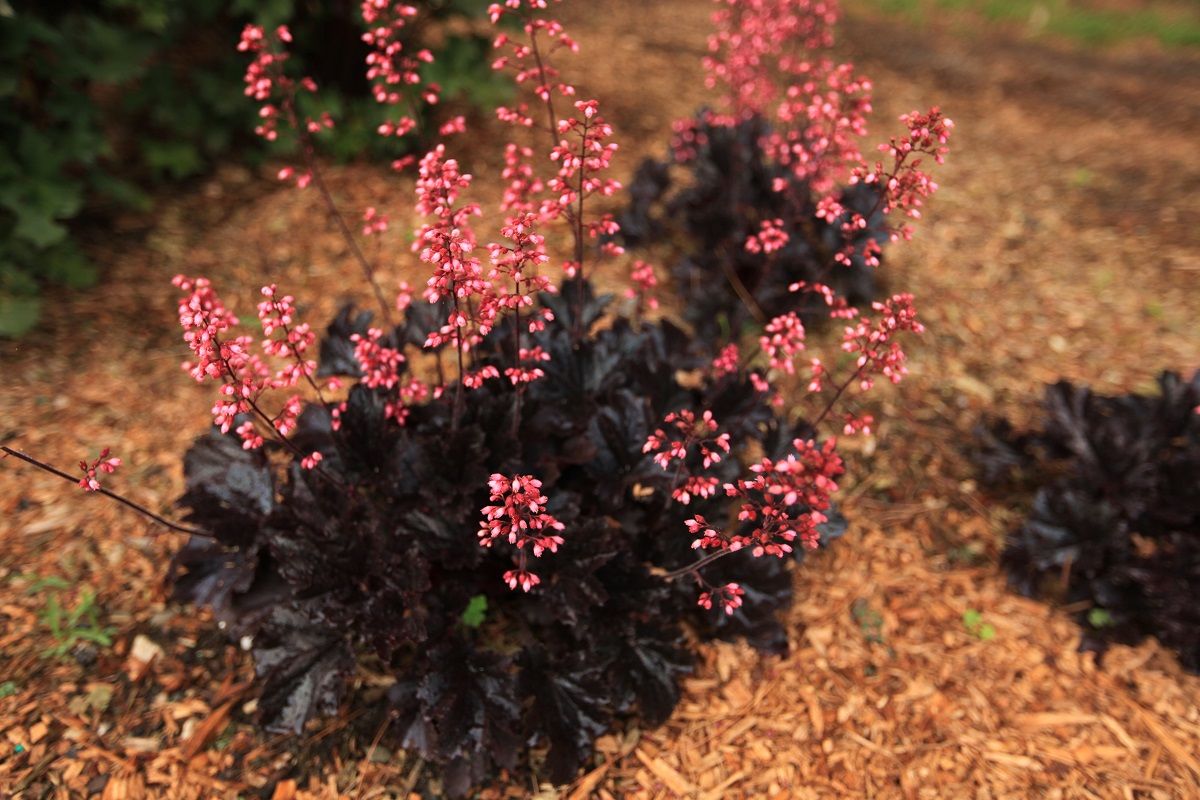
Heuchera ‘Timeless Night’ PP32,134

Blooming Time

July
August
September

Exposure

True
Full Sun
True
Light Shade
True
Moderate Shade
True
Dense Shade

`Timeless Night’ is a lovely, compact Heuchera forming neat mounds of dark, ruffle edged, purple-black foliage. But foliage is not the star of this Heuchera, this rebloomer steals the show with clouds of deep pink flower spires that hover above the foliage all summer long. This versatile variety can be sited nearly anywhere due to its tolerance of full sun or dense shade. Borders, containers, or mixed perennial gardens are all great choices for this plant.

Details

Hardiness Zone:

4

Blossom Color:

Rose to Pink

Growth Habit:

Clump Forming

Max Height:

1½'

Texture:

Medium Texture

Recommended Spacing:

14" to 1½'

We sell this plant in these containers:
#1 Pot
#1 Pot

Special Characteristics

True
Cuttings
True
Seasonal Effect
True
Moderate Area
True
Drought Tolerant
True
Native Hybrid
True
Hummingbird
True
Butterflies
True
Bees
True
Small Area
True
Evergreen
True
Rebloomer

Features

Neat mounds of dark, ruffle edged, purple-black foliage with clouds of deep pink flower spires.

Landscape Value

This versatile variety can be sited nearly anywhere due to its tolerance of full sun or dense shade. Borders, containers, or mixed perennial gardens are all great choices for this plant.

Care

Watering:

`Timeless Night' Heuchera is moderately drought tolerant but benefits from occasional watering, to maintain soil in a moist but not wet condition, during the summer months.

Fertilizing:

`Timeless Night' Heuchera is a moderate feeder, benefiting from a couple of annual applications of slow release fertilizer. A spring application of a 3-1-2 ratio (such as a 15-5-10) can be applied at a rate of about 10 pounds per 1000 square feet, and during early fall, an application of a 2-1-2 ratio (such as a 10-5-10) can be applied to encourage root development and cold hardiness.

Pruning:

`Timeless Night' Heuchera is a deciduous plant (nonevergreen) and does not require pruning. It is perfectly acceptable to allow the dropped leaves to decompose and nourish the soil.

Companion Plants

Astilbe chinensis ‘Vision in Red’View
Astilbe, `Vision in Red'
Astilbe chinensis ‘Lowlands Ruby Red’View
Astilbe, `Lowlands Ruby Red'
Astilbe x japonica ‘Elizabeth van Veen’View
Astilbe, `Elizabeth van Veen'
Astilbe chinensis ‘Visions’View
Astilbe, `Visions'
Astilbe chinensis ‘Maggie Daley’View
Astilbe, `Maggie Daley'
Heuchera ‘Forever Purple’ PP26,358View
Coral Bells, `Forever Purple'
Heuchera ‘Berry Smoothie’ PP21,871View
Coral Bells, `Berry Smoothie'
Heuchera ‘Red Lightning’ PP27,767View
Coral Bells, `Red Lightning'
Heuchera `’Timeless Glow’ PPAFView
Coral Bells, `Timeless Glow'
Nepeta x faassenii ‘Purrsian Blue’ PP24,788View
Nepeta, `Purrsian Blue'
Nepeta x faassenii Junior Walker™ PP23,074View
Nepeta, Junior Walker™
Nepeta x faassenii ‘Blue Wonder’View
Nepeta, Hybrid, `Blue Wonder'
Origanum rotundifolium ‘Kent Beauty’View
Oregano, `Kent Beauty'
Perovskia atriplicifolia ‘Little Spire’View
Sage, Russian, `Little Spire'
Perovskia atriplicifolia ‘Filigran’View
Sage, Russian, `Filigran'
Perovskia atriplicifolia ‘Blue Jean Baby’ PP29,281View
Sage, Russian, `Blue Jean Baby'
Phlox paniculata ‘Red Riding Hood’View
Phlox, Garden, `Red Riding Hood'
Phlox paniculata `Glamour Girl’ PP25,778View
Phlox, Garden, `Glamour Girl'
Phlox paniculata ‘Fashionably Early Flamingo’ PP29,911View
Phlox, Garden, `Fashionably Early Flamingo'
Phlox paniculata ‘Blue Paradise’View
Phlox, Garden, `Blue Paradise'
Phlox paniculata Bambini® ‘Cherry Crush’ PP33,334View
Phlox, Bambini® Cherry Crush
Salvia nemorosa ‘Spring King’View
Sage, `Spring King'
Salvia nemorosa ‘Midnight Rose’ PPAFView
Sage, 'Midnight Rose'
Salvia Fashionista® ‘Moulin Rouge’ PP32,387View
Sage, Perennial, Fashionista® `Moulin Rouge'
Salvia ‘Bumbleberry’View
Sage, Perennial, `Bumbleberry'
Salvia nemorosa ‘May Night’View
Sage, `May Night'
Salvia nemorosa ‘Sensation Sky Blue’ PPAFView
Sage, 'Sensation Sky Blue'