Solidago Little Lemon®

Blooming Time

September
October

Exposure

True
Full Sun

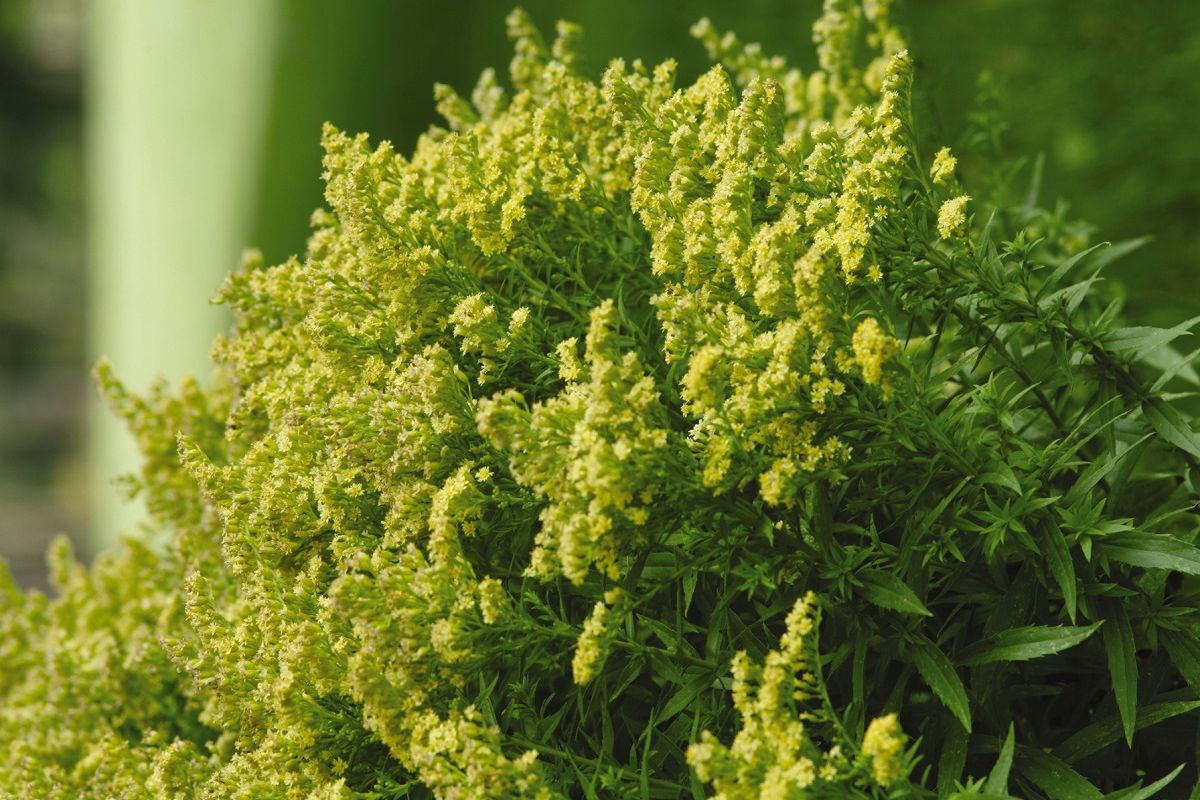
(Image Courtesy of Ball Horticulture) An adorable dwarf, Little Lemon’s® small mounds of compact unassuming foliage quietly complements neighboring companion plants until late summer, when it begins blooming. Then it sends up sprays of bright lemon-yellow, pollen laden blooms which cover the entire plant and provide an important late season food source for pollinators. Sometimes wrongly accused of causing “hay fever”, goldenrod is not to blame as its pollen does not blow around on the wind (Ragweed is the true culprit!). Use Little Lemon® virtually anywhere to add a splash of much needed fall color and to help out our pollinator friends.

Details

Hardiness Zone:

5

Blossom Color:

Yellow to Chartreuse

Growth Habit:

Shrubby

Max Height:

16"

Texture:

Fine Texture

Recommended Spacing:

1½' to 2'

We sell this plant in these containers:
#1 Pot
#1 Pot

Special Characteristics

True
Cuttings
True
Seasonal Effect
True
Moderate Area
True
Drought Tolerant
True
Butterflies
True
Bees
True
Large Area
True
Deer Resistant
True
Sandy Soil Tolerant
True
Native Cultivar

Features

Sprays of bright lemon-yellow, pollen laden blooms cover the entire plant.

Landscape Value

Use Little Lemon® virtually anywhere to add a splash of much needed fall color and to help out our pollinator friends.

Care

Watering:

Little Lemon® Goldenrod is moderately drought tolerant but benefits from occasional watering, to maintain soil in a moist but not wet condition, during the summer months.

Fertilizing:

Little Lemon® Goldenrod needs little fertilizer, but benefits from a single springtime or fall topdressing (about 1 inch deep) of organic compost or well rotted leaves. Alternatively, a springtime application of a slow release fertilizer with a 3-1-2 ratio (such as a 15-5-10) can be applied at a rate of about 10 pounds per 1000 square feet.

Pruning:

Little Lemon® Goldenrod should be enjoyed all winter long, then, during early April before it begins to grow again, it should be pruned or mowed back to ground level.

Companion Plants

Aster ‘Wood’s Light Blue’View
Aster, `Wood's Light Blue'
Aster novae-angliae ‘Grape Crush’ PP33,612View
Aster, New England, `Grape Crush'
Aster oblongifolius ‘October Skies’View
Aster, Aromatic, `October Skies'
Coreopsis ‘Red Satin’ PP25,736View
Coreopsis, `Red Satin'
Coreopsis Li’l Bang™ ‘Darling Clementine’ PP31,843View
Coreopsis, Li'l Bang™ `Darling Clementine'
Coreopsis Leading Lady ‘Lauren’ PPAFView
Coreopsis, Leading Lady `Lauren'
Coreopsis grandiflora ‘Heliot’View
Coreopsis, `Heliot'
Coreopsis ‘Citrine’ PP22,470View
Coreopsis, `Citrine'
Coreopsis verticillata ‘Moonbeam’View
Coreopsis, Threadleaf `Moonbeam'
Eupatorium coelestinumView
Mistflower, Blue
Eupatorium ‘Phantom’ PP18,354View
Joe-Pye Weed, `Phantom'
Eupatorium Rosie Josie™ (`Noneisoj’)View
Joe-Pye Weed, Rosie Josie™
Nepeta x faassenii ‘Purrsian Blue’ PP24,788View
Nepeta, `Purrsian Blue'
Nepeta x faassenii Junior Walker™ PP23,074View
Nepeta, Junior Walker™
Nepeta subsessilus Prelude™ Purple PP33,997View
Catmint, Large Flowered Prelude™ Purple
Monarda didyma Grand Parade™ PP19,580View
Bee Balm, Grand Parade™
Monarda didyma Grand Marshall™ PP19,582View
Bee Balm, Grand Marshall™
Monarda didyma Pocahontas Red RoseView
Bee Balm, Pocahontas Red Rose
Monarda didyma ‘Purple Rooster’View
Bee Balm, `Purple Rooster'
Rudbeckia x ‘Glitters Like Gold’ PP30,933View
Coneflower, Orange, `Glitters Like Gold'
Rudbeckia fulgida var. sullivantii ‘Little Goldstar’View
Coneflower, Orange, `Little Goldstar' Dwarf
Rudbeckia fulgida var. deamiiView
Coneflower, Orange, Deam's
Vernonia ‘Summer’s Swan Song’ PP28,556View
Ironweed, `Summer's Swan Song'
Sporobolus heterolepisView
Prairie Dropseed
Sporobolus heterolepsis ‘Tara’View
Prairie Dropseed, Dwarf, `Tara'
Pennisetum alopecuroides ‘Lumen Gold’ PP27,435View
Fountain Grass, `Lumen Gold'
Pennisetum alopecuroides ‘Hameln’View
Fountain Grass, `Hameln' Dwarf
Pennisetum alopecuroides Fuzzy Wuzzy® PPAF (‘Nonyzz’)View
Fountain Grass, Fuzzy Wuzzy®