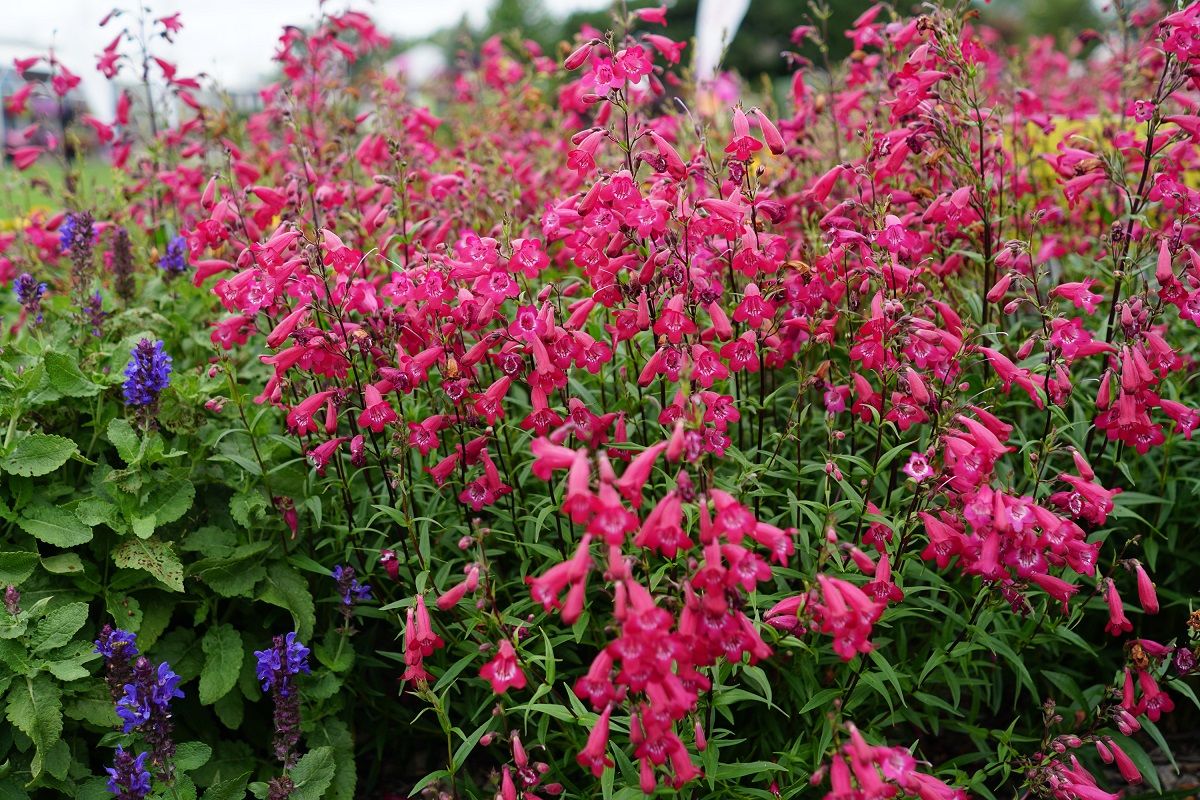
Penstemon barbatus MissionBells™ Deep Rose PP28,852

Blooming Time

June
July
August

Exposure

True
Full Sun

(Image Courtesy of Darwin Perennials) A hybrid variety, forming mounds of clean, waxy foliage; MissionBells™ Deep Rose is thought to be the showiest of all Penstemon, noted for its numerous spires of deep raspberry-red tubular flowers that begin in late spring and persist until mid-summer. These brilliant columns of hot-pink, trumpet-shaped blossoms are carried high, making them attractive to hummingbirds, as well as other pollinators. Requiring little maintenance, and resistant to drought, MissionBells™ Rose works best in sunny areas with well drained soil.

Details

Hardiness Zone:

5

Blossom Color:

Red

Growth Habit:

Clump Forming

Max Height:

2'

Texture:

Fine Texture

Recommended Spacing:

1½' to 2'

We sell this plant in these containers:

#1 Pot
#1 Pot

Special Characteristics

True
Cuttings
True
Seasonal Effect
True
Salt Tolerant
True
Drought Tolerant
True
Hummingbird
True
Butterflies
True
Bees
True
Large Area

Features

Brilliant columns of hot-pink, trumpet-shaped blossoms are carried high, making them attractive to hummingbirds.

Landscape Value

Requiring little maintenance, and resistant to drought, MissionBells™ Rose works best in sunny areas with well drained soil.

Care

Watering:

MissionBells™ Deep Rose Beard Tongue is moderately drought tolerant but benefits from occasional watering, to maintain soil in a moist but not wet condition, during the summer months.

Fertilizing:

MissionBells™ Deep Rose Beard Tongue is a moderate feeder, benefiting from a couple of annual applications of slow release fertilizer. A spring application of a 3-1-2 ratio (such as a 15-5-10) can be applied at a rate of about 10 pounds per 1000 square feet, and during early fall, an application of a 2-1-2 ratio (such as a 10-5-10) can be applied to encourage root development and cold hardiness.

Pruning:

MissionBells™ Deep Rose Beard Tongue should be enjoyed all winter long, then, during early April before it begins to grow again, it should be pruned or mowed back to ground level.

Companion Plants

Echinacea Cara Mia™ Yellow PP31,142View
Coneflower, Cara Mia™ Yellow
Echinacea ‘Big Kahuna’ PP22,159View
Coneflower, `Big Kahuna'
Echinacea Fine Feathered™ Parrot PPAFView
Coneflower, Fine Feathered™ Parrot
Echinacea ‘Orange Skipper’ PPAFView
Coneflower, `Orange Skipper'
Echinacea Prima™ Ginger PP30,169View
Coneflower, Prima™ Ginger
Echinacea Prima™ Saffron PPAFView
Coneflower, Prima™ Saffron
Echinacea Sombrero® Adobe Orange PP26,639View
Coneflower, Sombrero® Adobe Orange
Echinacea Sombrero® Granada Gold PP30,115View
Coneflower, Sombrero® Granada Gold
Echinacea Sombrero® Lemon Yellow Improved PP30,116View
Coneflower, Sombrero® Lemon Yellow Improved
Allium Glitterbug® All A’ Flutter (`Nonrettu’)View
Ornamental Chive, All A' Flutter
Allium Glitterbug® Bee’s Knees® (`Nonseenk’)View
Ornamental Chive, Bee's Knees®
Allium Glitterbug® Humble Bumble® (`Nonelbmu’)View
Ornamental Chive, Humble Bumble®
Allium Glitterbug® Pink Moon Rising® (‘Nongnisl’)View
Ornamental Chive, Pink Moon Rising®
Allium ‘Windy City’ PP28,100View
Ornamental Chive, `Windy City'
Amsonia ‘Starstruck’ PP32,246View
Blue Star, `Starstruck'
Amsonia ‘Blue Ice’View
Blue Star, `Blue Ice'
Amsonia x Butterscotch™View
Blue Star, Butterscotch™
Amsonia ciliata ‘Verdant Venture’ PP33,415View
Blue Star, Fringed, `Verdant Venture'
Amsonia hubrichtii ‘Halfway to Arkansas’View
Blue Star, Narrow Leaf, `Halfway to Arkansas'
Asclepias incarnata ‘Cinderella’View
Milkweed, Swamp, `Cinderella'
Asclepias tuberosaView
Milkweed, Butterfly
Asclepias tuberosa var. InteriorView
Milkweed, Butterfly
Aster ‘Wood’s Light Blue’View
Aster, `Wood's Light Blue'
Aster novae-angliae ‘Grape Crush’ PP33,612View
Aster, New England, `Grape Crush'
Aster oblongifolius ‘October Skies’View
Aster, Aromatic, `October Skies'
Coreopsis ‘Red Satin’ PP25,736View
Coreopsis, `Red Satin'
Coreopsis Li’l Bang™ ‘Darling Clementine’ PP31,843View
Coreopsis, Li'l Bang™ `Darling Clementine'
Coreopsis Leading Lady ‘Lauren’ PPAFView
Coreopsis, Leading Lady `Lauren'
Coreopsis grandiflora ‘Heliot’View
Coreopsis, `Heliot'
Calamagrostis x acutiflora ‘Karl Foerster’View
Feather Reed Grass, Karl Foerster's
Calamagrostis x acutiflora `Overdam’View
Feather Reed Grass, Variegated
Calamagrostis arundinacea var. brachytrichaView
Feather Reed Grass, Fall Blooming
Festuca glauca ‘Beyond Blue’ PP23,307View
Fescue, Blue, `Beyond Blue'
Festuca glauca ‘Boulder Blue’View
Fescue, `Boulder Blue'