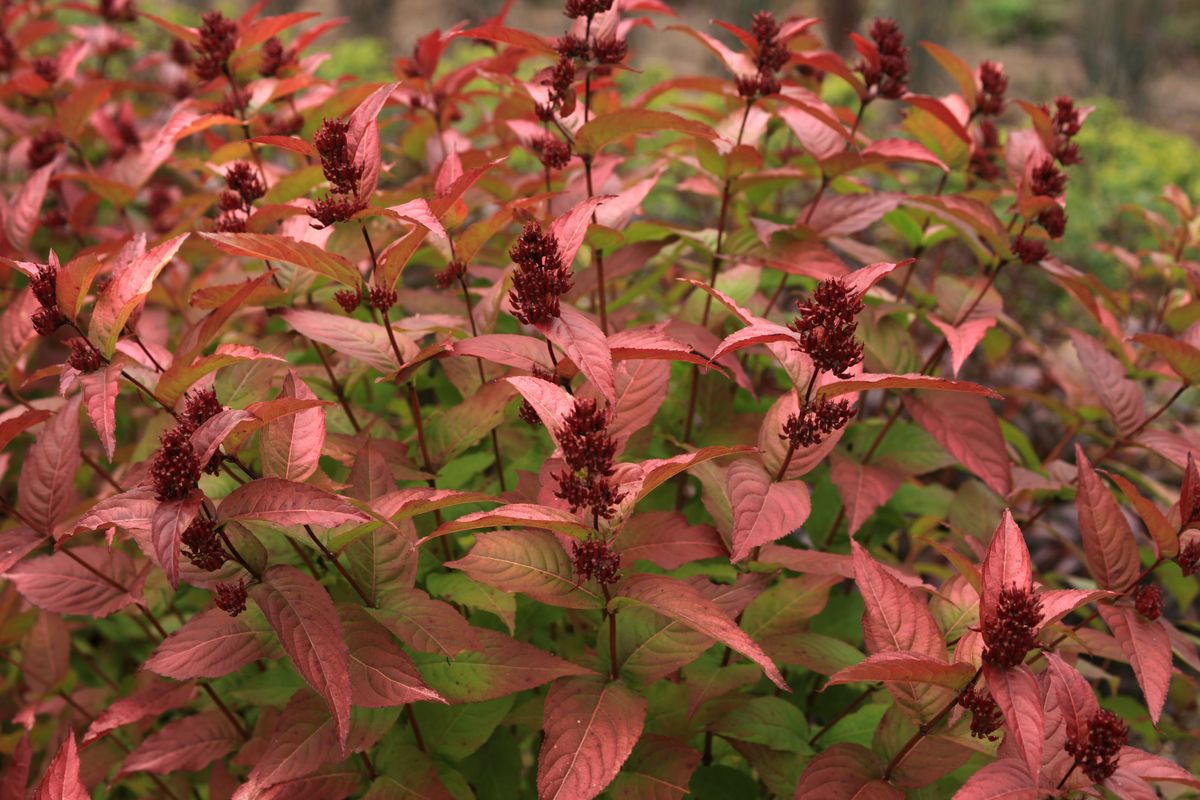
Leafing out as early as March, Autumn Inferno® starts the season with wine-stained chartreuse foliage that fully matures by late spring when the lemon-yellow trumpet-shaped flowers begin to open. Lasting through July and carried in compact inflorescences, the flowers lead to upright elongate seed clusters which become increasingly red as the season progresses. By fall, when the foliage becomes cinnamon-red, the seeds have also darkened to a deep, burnished red. Together the seeds and the foliage are quite spectacular, providing rich red color to the autumn landscape.
×
Quantity Calculator
Details
Hardiness Zone:
4
Blossom Color:
Yellow to Chartreuse
Growth Habit:
Shrubby
Max Height:
4'
Texture:
Coarse Texture
Recommended Spacing:
4' to 4½'
We sell this plant in these containers:
#2 Pot
Special Characteristics
Moderate Area
Salt Tolerant
Drought Tolerant
Native Hybrid
Hummingbird
Bees
Large Area
Sandy Soil Tolerant
Hortech Original
Controls Erosion
Features
Wine-stained chartreuse foliage, lemon-yellow trumpet-shaped flowers, in autumn seed clusters and foliage develop deep red tones.
Landscape Value
A natural looking hedge, introduced shrub alternative (replacing Weigela or Spirea), grows well with numerous companions.
Care
Watering:
Mountaineer® Autumn Inferno™ Bush Honeysuckle is moderately drought tolerant but benefits from occasional watering, to maintain soil in a moist but not wet condition, during the summer months.
Fertilizing:
Mountaineer® Autumn Inferno™ Bush Honeysuckle is a moderate feeder, benefiting from a couple of annual applications of slow release fertilizer. A spring application of a 3-1-2 ratio (such as a 15-5-10) can be applied at a rate of about 10 pounds per 1000 square feet, and during early fall, an application of a 2-1-2 ratio (such as a 10-5-10) can be applied to encourage root development and cold hardiness.
Pruning:
Mountaineer® Autumn Inferno™ Bush Honeysuckle sets its flower buds in summer, and any pruning should be conducted in April, immediately after winter.