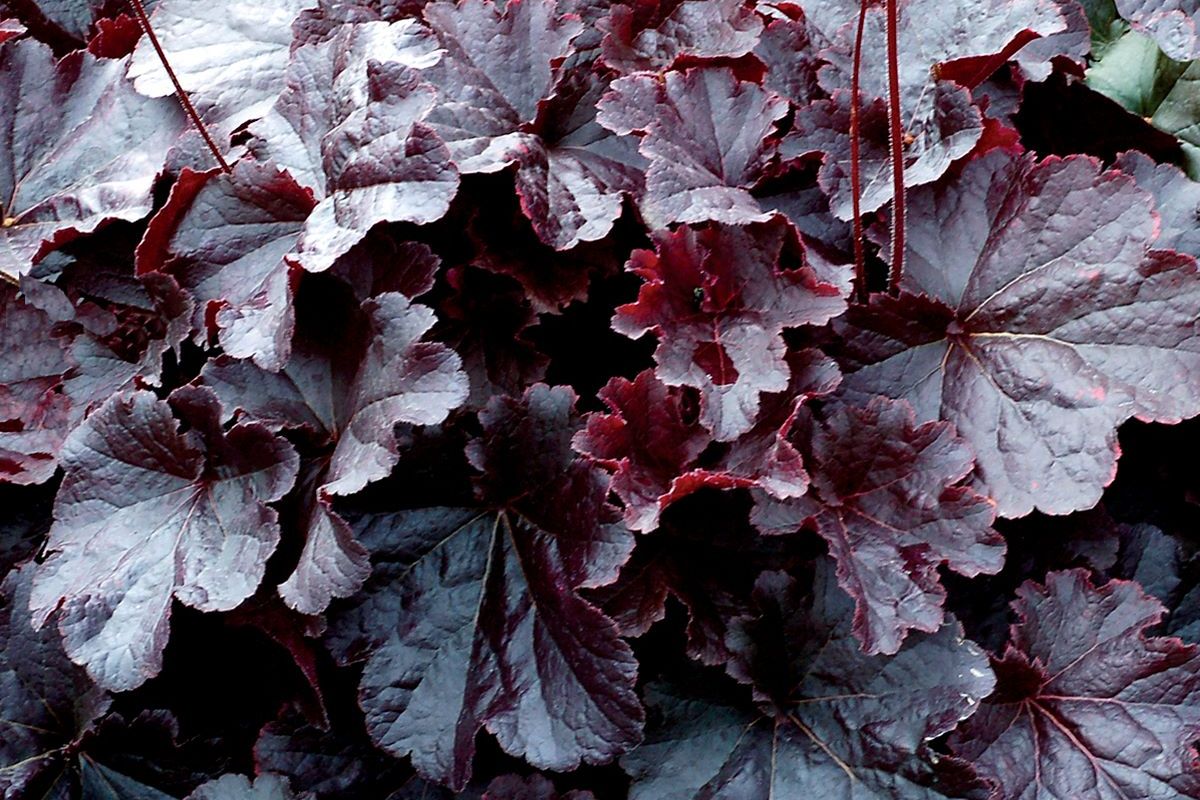
Photo courtesy of Terra Nova Nurseries. Northern Exposure™ Black is notable for its excellent winter hardiness and longevity as well as its large, rounded, black foliage with striking red undersides. Forming lovely mid-size mounds, these well-mannered plants are adorned with bell-shaped flowers that hover above dark foliage upon wiry stems. Northern Exposure™ Black Coral Bells is also unique for its tolerance of full sun as well as dense shade, making the possibilities for siting this plant endless. A stunner en-masse, or in mixed perennial gardens, it has a place in nearly every garden especially when used in combination with companions.
×
Quantity Calculator
Details
Hardiness Zone:
3
Blossom Color:
White to Cream
Growth Habit:
Clump Forming
Max Height:
12"
Texture:
Medium Texture
Recommended Spacing:
1½' to 2'
We sell this plant in these containers:
#1 Pot
Special Characteristics
Cuttings
Seasonal Effect
Moderate Area
Drought Tolerant
Native Hybrid
Hummingbird
Butterflies
Bees
Small Area
Evergreen
Sandy Soil Tolerant
Features
Excellent winter hardiness and large, rounded black foliage with striking red undersides.
Landscape Value
A stunner en-masse, or in mixed perennial gardens, Northern Exposure™ Black has a place in nearly any perennial garden.
Care
Watering:
Northern Exposure™ Black Coral Bells is moderately drought tolerant but benefits from occasional watering, to maintain soil in a moist but not wet condition, during the summer months.
Fertilizing:
Northern Exposure™ Black Coral Bells is a moderate feeder, benefiting from a couple of annual applications of slow release fertilizer. A spring application of a 3-1-2 ratio (such as a 15-5-10) can be applied at a rate of about 10 pounds per 1000 square feet, and during early fall, an application of a 2-1-2 ratio (such as a 10-5-10) can be applied to encourage root development and cold hardiness.
Pruning:
Northern Exposure™ Black Coral Bells is a deciduous plant (nonevergreen) and does not require pruning. It is perfectly acceptable to allow the dropped leaves to decompose and nourish the soil.