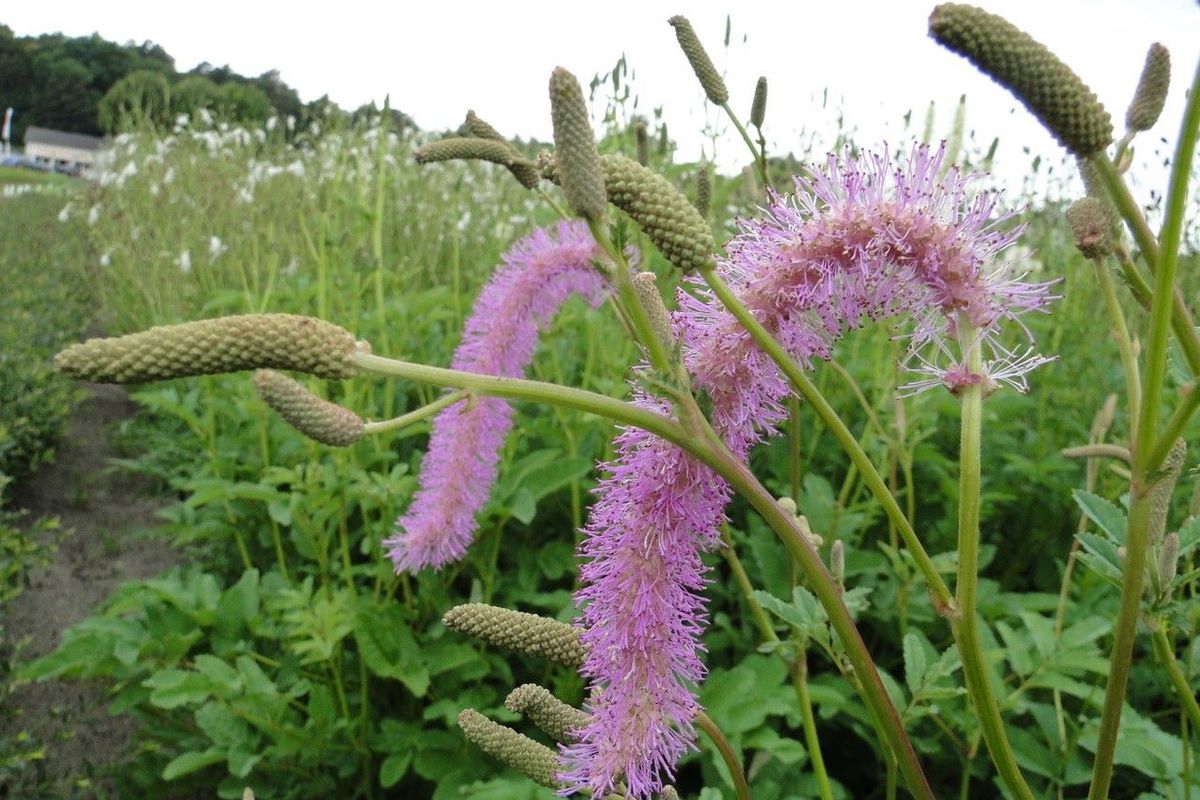
Hiding in the shadows for far too long, it’s time for Sanguisorba to get some recognition, and `Lilac Squirrel’ will make that happen. `Lilac Squirrel’ is clothed in blue-green, tooth-edged pinnate leaves that form a lush tropical looking tussock. This is so engaging that if `Lilac Squirrel’ never bloomed it would still be prized as a foliage plant. But`Lilac Squirrel is just as exceptional for its flowers. During early summer 3-foot-tall stems emerge through the foliage bearing bottle-brush, squirrel-tail shaped, hot pink flowers known as “catkins”, which dangle and sway in the slightest breeze. These are flowers that beg to be touched and for this reason it is a ‘must have’ plant for most any garden, especially children’s gardens, sensory gardens and along paths and walkways.
×
Quantity Calculator
Details
Hardiness Zone:
5
Blossom Color:
Rose to Pink
Growth Habit:
Clump Forming
Max Height:
3'
Texture:
Fine Texture
Recommended Spacing:
1½' to 2'
We sell this plant in these containers:
#1 Pot
Special Characteristics
Cuttings
Seasonal Effect
Moderate Area
Bees
Large Area
Deer Resistant
Features
Blue-green, tooth-edged foliage forms lush tropical looking tussocks, 3-foot-tall stems emerge in early summer with bottle-brush, squirrel-tail shaped hot pink flowers.
Landscape Value
Children's gardens, sensory gardens, along paths and walkways- a 'must have' for nearly any garden.
Care
Watering:
`Lilac Squirrel' Burnet is moderately drought tolerant but benefits from occasional watering, to maintain soil in a moist but not wet condition, during the summer months.
Fertilizing:
`Lilac Squirrel' is a moderate feeder, benefiting from a couple of annual applications of slow release fertilizer. A spring application of a 3-1-2 ratio (such as a 15-5-10) can be applied at a rate of about 10 pounds per 1000 square feet, and during early fall, an application of a 2-1-2 ratio (such as a 10-5-10) can be applied to encourage root development and cold hardiness.
Pruning:
`Lilac Squirrel' Burnet should be enjoyed all winter long, then, during early April before it begins to grow again, it should be pruned or mowed back to ground level.