
Aster macrophyllus (syn. Eurybia macrophylla)
Blooming Time

August
September

Exposure

True
Dense Shade
True
Moderate Shade

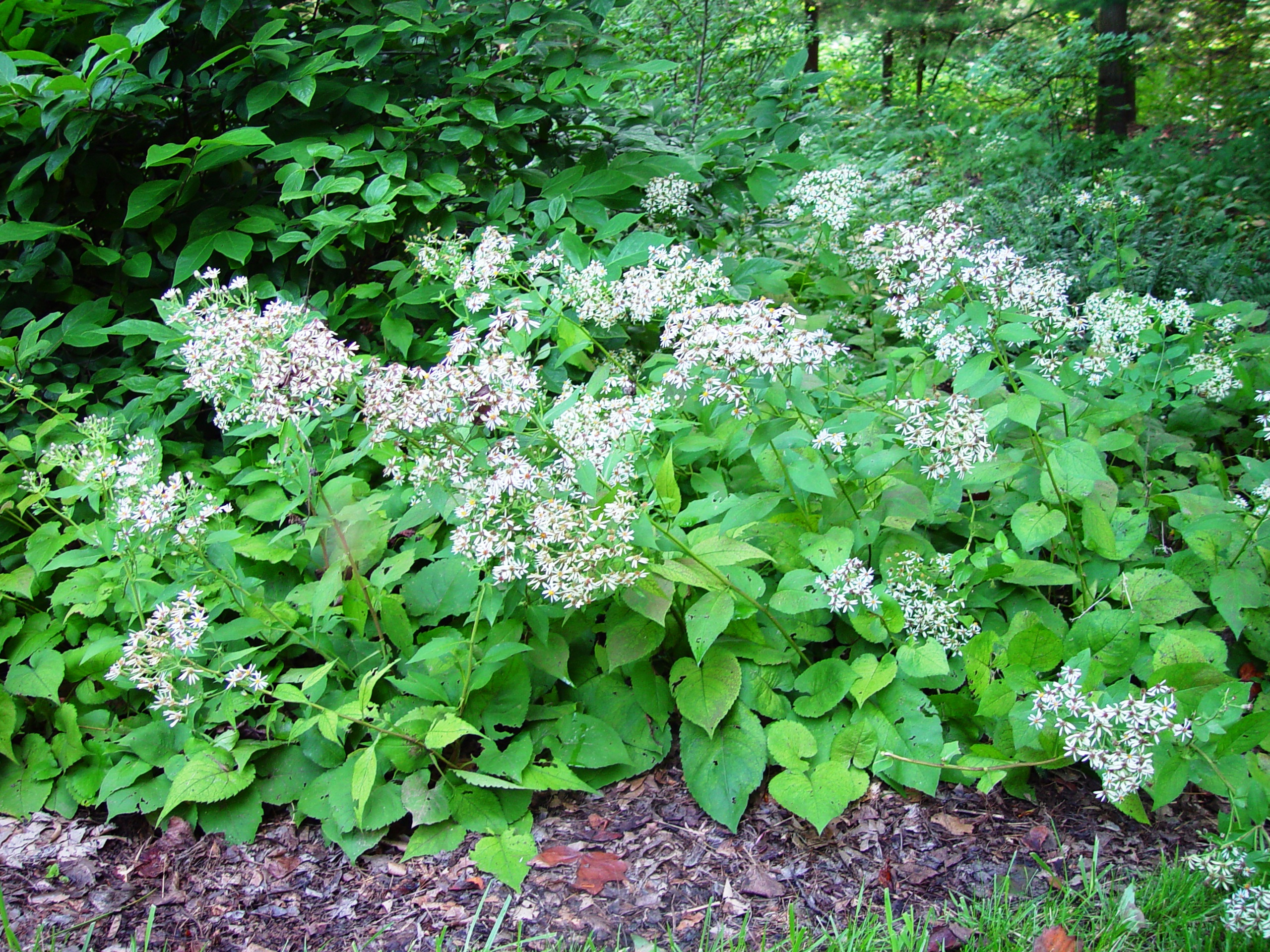
(Image courtesy of Mt. Cuba Center) Big-Leaved Aster is a robust native species, forming clumps of broad, heart-shaped, basal foliage; with individual leaves spanning up to 8-inches. This woodland colonizer functions well as a shade-tolerant groundcover, but in late summer and fall it is adorned with tiny daisy-shaped, dainty pale-blue petaled, yellow centered flowers. Aster macrophyllus is beneficial to pollinators for its ample supply of late season pollen and nectar and is usually ignored by deer and other pests. Big-Leaved Aster is also quite adaptable, spreading by rhizomes and tolerating both dry and moist soil conditions, making it ideal for naturalizing in shady areas, especially along woodland borders.

Details

Hardiness Zone:

3

Blossom Color:

Blue to Blue Gray

Growth Habit:

Clump Forming

Max Height:

3'

Texture:

Coarse Texture

Recommended Spacing:

3' to 4'

We sell this plant in these containers:
#1 Pot
#1 Pot

Special Characteristics

True
Bees
True
Butterflies
Controls Erosion
True
Deer Resistant
True
Drought Tolerant
True
Large Area
True
Moderate Area
True
Moisture Tolerant
True
Native Species
True
Sandy Soil Tolerant
True
Seasonal Effect

Features

Clumps of broad, heart-shaped, basal foliage adorned with tiny daisy-shaped, dainty pale-blue petaled, yellow centered flowers.

Landscape Value

Big-Leaved Aster is also quite adaptable, spreading by rhizomes and tolerating both dry and moist soil conditions, making it ideal for naturalizing in shady areas, especially along woodland borders.

Care

Watering:

Big-Leaved Aster is moderately drought tolerant but benefits from occasional watering, to maintain soil in a moist but not wet condition, during the summer months.

Fertilizing:

Big-Leaved Aster is a moderate feeder, benefiting from a couple of annual applications of slow release fertilizer. A spring application of a 3-1-2 ratio (such as a 15-5-10) can be applied at a rate of about 10 pounds per 1000 square feet, and during early fall, an application of a 2-1-2 ratio (such as a 10-5-10) can be applied to encourage root development and cold hardiness.

Pruning:

Big-Leaved Aster should be enjoyed all winter long, then, during early April before it begins to grow again, it should be pruned or mowed back to ground level.

Companion Plants

Onoclea sensibilisView
Fern, Sensitive
Osmunda claytonianaView
Fern, Interrupted
Osmunda regalisView
Fern, Royal
Aruncus ‘Misty Lace’View
Goat's Beard, `Misty Lace'
Aruncus dioicusView
Goat's Beard
Asclepias tuberosaView
Milkweed, Butterfly
Asclepias incarnata ‘Cinderella’View
Milkweed, Swamp, `Cinderella'
Asclepias tuberosa ‘Hello Yellow’View
Milkweed, Butterfly, 'Hello Yellow'
Asclepias tuberosa var. InteriorView
Milkweed, Butterfly
Aster ‘Wood’s Light Blue’View
Aster, `Wood's Light Blue'
Aster macrophyllus (syn. Eurybia macrophylla)View
Aster, Big-Leaved
Aster novae-angliae ‘Grape Crush’ PP33,612View
Aster, New England, `Grape Crush'
Aster oblongifolium ‘Cotton Candy’ PP34,580View
Aster, Aromatic, `Cotton Candy'
Aster oblongifolius ‘October Skies’View
Aster, Aromatic, `October Skies'
Baptisia ‘American Goldfinch’ PP30,478View
Indigo, Wild, `American Goldfinch'
Baptisia ‘Burgundy Blast’ PP34,689View
Indigo, False, `Burgundy Blast'
Baptisia `Honey Roasted’ PP34,707View
Indigo, False, `Honey Roasted'
Baptisia australisView
Indigo, False, Blue
Epimedium grandiflorum ‘Lilafee’View
Epimedium, Lilac Fairy
Epimedium grandiflorum var. higoense ‘Bandit’View
Epimedium, `Bandit'
Epimedium warleyenseView
Epimedium, Orange Flowered
Epimedium x ‘After Midnight’View
Epimedium, `After Midnight'
Epimedium x ‘Rubrum’View
Epimedium, Red Leaved
Epimedium x versicolor ‘Sulphureum’View
Epimedium, Yellow Flowered
Heuchera ‘Forever Purple’ PP26,358View
Coral Bells, `Forever Purple'
Heuchera ‘Lemon Love’ PP31,223View
Coral Bells, `Lemon Love'
Heuchera ‘Obsidian’View
Coral Bells, `Obsidian'
Heuchera `’Timeless Glow’ PPAFView
Coral Bells, `Timeless Glow'
Solidago Little Lemon®View
Goldenrod, Little Lemon®
Solidago rugosa ‘Fireworks’View
Goldenrod, `Fireworks'
Carex Feather Falls™ PP26,199View
Sedge, Feather Falls™
Carex appalachicaView
Sedge, Appalachian
Carex hachijoensis ‘Evergold’View
Sedge, Japanese, `Evergold'
Carex elata ‘Bowles Golden’View
Sedge, `Bowles Golden'
Carex morrowii ‘Ice Dance’View
Sedge, `Ice Dance'
Carex oshimensis EverColor® ‘Everest’ (`CarFit01′) PP20,955View
Sedge, `Everest'
Carex oshimensis EverColor® ‘Everillo’ PP21,002View
Sedge, EverColor® `Everillo'
Carex pensylvanicaView
Sedge, Pennsylvania
Carex roseaView
Sedge, Rosy
Carex strictaView
Sedge, Tussock
Hakonechloa macraView
Japanese Forest Grass
Hakonechloa macra ‘Albo-striata’View
Japanese Forest Grass, White Stripe
Hakonechloa macra ‘All Gold’View
Japanese Forest Grass, `All Gold'
Hakonechloa macra ‘Aureola’View
Japanese Forest Grass, Golden-leaved